Roth vs traditional: pay the tax now or later
Roth or traditional? When you pay the tax on each, a $1,000 example, the 2026 limits, the employer match and taking money out early, in plain English.

You start a new job, and somewhere in the signup screens is a choice between two boxes. Nobody at home ever had to make it, so you leave it the way it was, click next, and don’t think about it again for years.
Say that from age 25 to 65, you put $500 a month into low-cost index funds, which hold a whole group of stocks or bonds instead of picking a few. If it grows 6% a year on average, which isn’t guaranteed, the $240,000 you put in becomes about $1 million.
That assumes two things: you keep investing every month, even when prices fall, and the market doesn’t stay down for a decade or two. Long slumps have happened before, so treat the million as an example, not a promise.
The box you pick decides when you pay income tax on that money: now, with Roth, or when you take it out, with traditional (pre-tax). For how to invest it once it’s in, I’d point most people to a three-fund (Bogleheads) mix of low-cost index funds, held for decades.
Below, you’ll see when each one wins with one $1,000 example, how to find your own tax rate, and the rules on limits and taking money out.
Traditional saves tax now, Roth saves it later
Traditional (pre-tax): what you put in (your contributions) comes out of your pay before federal income tax, so less of this year’s pay is taxed. In retirement, everything you take out is taxed as income, both what you put in and its growth (your earnings).
Roth (after-tax): what you put in comes out of your pay after income tax, so there’s no break today. In return, once you’re 59½ and the account is at least five years old, what you take out is tax-free, growth and all.
Workplace plans like a 401(k), 403(b) or government 457(b) can offer both. If yours does, you can split what you put in between them any way you like. A Roth 401(k) has no income limit. IRAs, which you open yourself, come in the same two types.
Same $1,000 of pay: when each one wins
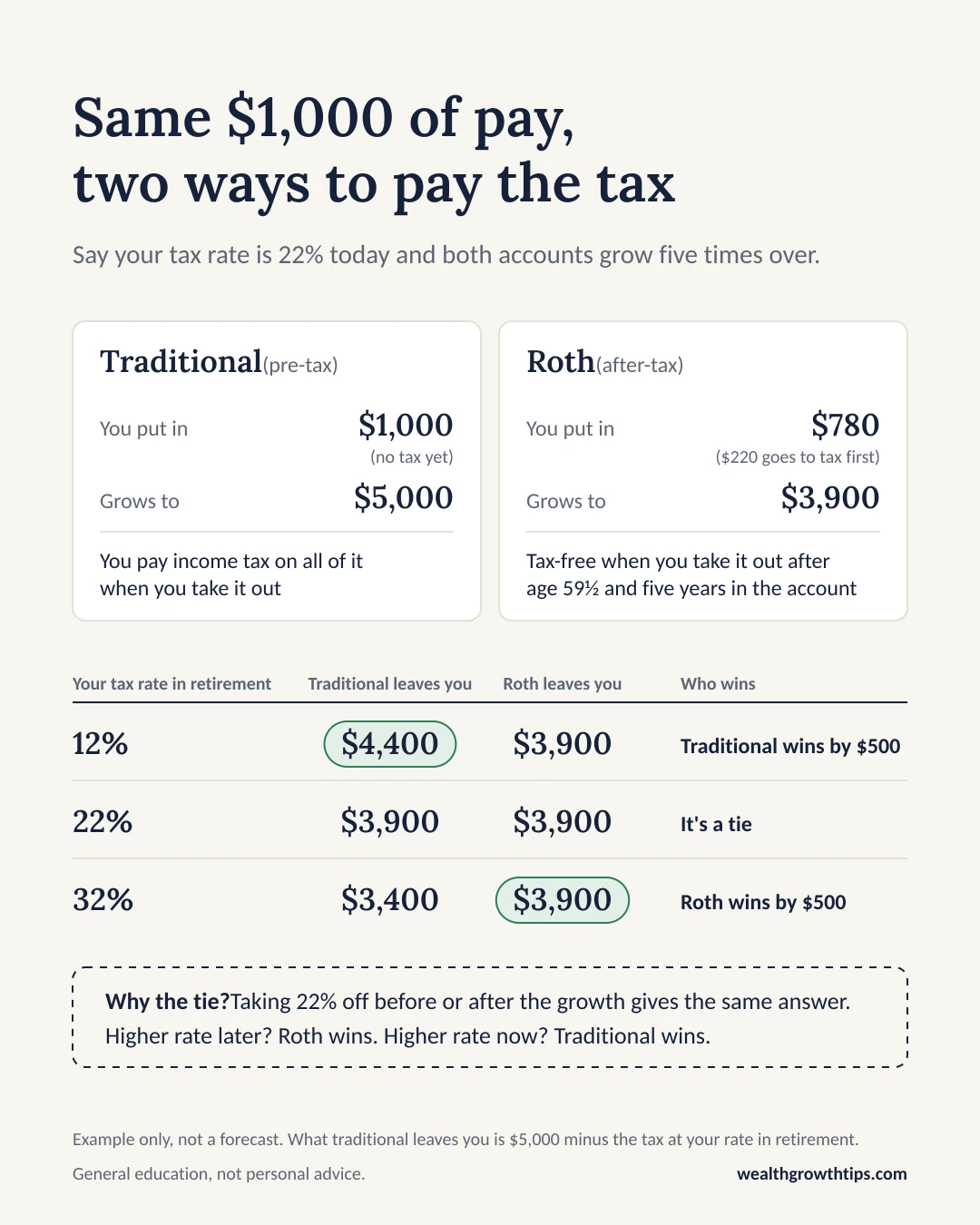
Say you set aside $1,000 of pay at a 22% tax rate. Traditional puts the whole $1,000 in. Roth puts in $780, because 22% of it, $220, goes to tax first.
Now say both grow five times over (an example, not a forecast). Traditional becomes $5,000, and Roth becomes $3,900, all of it tax-free. What traditional leaves you depends on your tax rate when you take it out:
- 12% in retirement: traditional leaves $4,400 after tax, against Roth’s $3,900. Traditional wins by $500.
- 22% in retirement: traditional leaves $3,900 after tax, the same as Roth. It’s a tie.
- 32% in retirement: traditional leaves $3,400 after tax, against Roth’s $3,900. Roth wins by $500.
Why the tie? Taking 22% off before or after the growth gives the same answer. Both cost you the same $780 of take-home pay today, since traditional puts in $220 more but also cuts your tax by $220.
Your tax rate now vs later decides it
It comes down to one comparison: your tax rate on this money today versus your rate when you take it out. If it’s higher today, traditional wins. If it’s higher later, Roth wins.
Federal income tax works in layers. In 2026, if you’re single, your income after deductions (your tax return calls this taxable income) is taxed like this:
- 10% on your first $12,400
- 12% on the next layer, up to $50,400
- 22% on the layer above $50,400
- 24%, 32%, 35% and 37% on higher layers
For married couples filing jointly, the 12% and 22% layers start above $24,800 and $100,800. Each rate applies only to the income inside its layer, so use the tax rate on your last dollars of pay (your tax bracket), not the share of your total income that goes to tax. Count state income tax too. For a quick, rough view, add your state’s rate to the federal rate, both now and later. Then check your own state’s rules.
Why early-career earners often lean Roth
If your career is just starting and you expect raises and promotions, today’s rate may be lower than your rate on withdrawals later. That’s the usual case for Roth early on, though it’s a tendency, not a rule.
Traditional can win if you’re already in a high bracket, expect much less income in retirement, or need the smaller drop in take-home pay to afford saving at all, for example while you’re also sending money home. Switch to Roth at the same percentage and your paycheck shrinks, though you’re also saving more after tax.
Unsure? You can split, say half and half. If your situation is complicated (a pension, a business, big swings in income), a fee-only professional can run the numbers with you.
Get the full match before you worry about the type
Neither type matters as much as getting your employer’s full match. Putting in more than the match comes later. Your credit cards and any other debt at 10% or more come first, then your emergency fund, then any debt above 6% except your mortgage, as what to do with extra money after paying your bills explains.
Matching money has traditionally gone in pre-tax, even when your own contributions are Roth. Plans can now offer a Roth match but don’t have to, so ask HR what yours allows.
What to do today
- Find the taxable income on last year’s federal tax return. Then use the 2026 layers above to see where your last dollars fall.
- In your plan account, check whether Roth is offered, which type you use now, and whether you’re getting the full match (try the match calculator).
- Pick a split you can explain in one sentence. Look at it again once a year, in your annual money checkup, or after a big raise.
More detail
How much can I put in each year?
For 2026, you can put up to $24,500 of your pay into a 401(k), 403(b), government 457 plan or the federal Thrift Savings Plan, pre-tax and Roth combined. If you’re 50 or older, your plan may let you put in up to $8,000 more. If you turn 60, 61, 62 or 63 in 2026, that extra can be up to $11,250. If you earned more than $150,000 from your employer last year, that extra has to go in as Roth. For IRAs, the limit is $7,500 across all of yours ($8,600 at 50 or older), or what you earned from work if that’s less. These limits, from IRS.gov, can change every year.
Does a Roth IRA have an income limit?
Yes. For 2026, if you’re single or head of household, the amount you can put in starts to shrink once your income passes $153,000, and it drops to zero at $168,000. For married couples filing jointly, it shrinks between $242,000 and $252,000. The IRS uses its own version of your income for this, called modified AGI.
What changes if my match goes in as Roth?
It counts as taxable income for the year it reaches your account, and no federal income tax is taken out of it. It’s only allowed if that match is fully yours to keep when it goes in (you’re fully vested).
Can I take money out early?
Neither account is a substitute for an emergency fund. From a Roth IRA, what you put in comes out first, and that part is tax-free any time. The growth is tax-free only after five years, counting from the first tax year you put money in, and once you’re 59½. Disability, death, or up to $10,000 in your lifetime for a first home can also count. Otherwise, the growth can be taxed, plus an extra 10% tax unless an exception applies. A Roth 401(k) is different. An early withdrawal comes out in the same mix as your balance, so part of it is taxed growth.
Will I have to take money out later?
From traditional accounts, usually yes. You have to take out a minimum amount each year, called a required minimum distribution (RMD), starting at 73. If you were born in 1960 or later, it starts at 75. Roth IRAs have none while the original owner is alive, and since 2024, neither do Roth accounts in 401(k) and 403(b) plans.
Will $1 million be worth as much in 40 years?
No. Prices rise over time, so a million then will buy less than a million does today. That’s one more reason to start early and raise what you save.
Can the government add money to what I save?
If your income is modest, it may. For 2026, the Saver’s Credit can cut your income tax by up to $1,000 ($2,000 for married couples filing jointly). Starting with tax year 2027, the Saver’s Match replaces it, putting up to $1,000 per person a year into the retirement account you name.
You don’t have to understand all of this today. You just have to not quit.
The free 10-day email course walks through this and nine other things nobody in my family could tell me about money.
General education, not personal advice.
Sources (23)
- IRS: 401(k) limit increases to $24,500 for 2026, IRA limit increases to $7,500
- IRS: Retirement topics - Catch-up contributions
- IRS: Retirement topics - IRA contribution limits
- IRS: Publication 590-A (2025), Contributions to Individual Retirement Arrangements (IRAs)
- IRS: Publication 590-B (2025), Distributions from Individual Retirement Arrangements (IRAs)
- IRS: Roth comparison chart
- IRS: Retirement plans FAQs on designated Roth accounts
- IRS: IRS releases tax inflation adjustments for tax year 2026, including amendments from the One, Big, Beautiful Bill
- IRS: Federal income tax rates and brackets
- IRS: Credits and deductions for individuals
- IRS: SECURE 2.0 Act impacts how businesses complete Forms W-2
- IRS: Internal Revenue Bulletin: 2024-02 (Notice 2024-2)
- IRS: Retirement topics - Required minimum distributions (RMDs)
- IRS: Internal Revenue Bulletin: 2024-33 (T.D. 10001)
- IRS: IRS reminds those aged 73 and older to make required withdrawals from IRAs and retirement plans by Dec. 31; notes changes in the law for 2023
- IRS: Retirement Savings Contributions Credit (Saver’s Credit)
- IRS: Saver’s Match
- 26 U.S.C. 402A (designated Roth contributions, including Roth matching contributions)
- 26 CFR 1.401(a)(9)-2 (required beginning age, 75 for people born in 1960 or later)
- 26 CFR 1.408A-6 (Roth IRA distributions)
- Federal Reserve History: Stock Market Crash of 1929
- Dimensional: A Tale of Two Decades
- Federal Reserve: What is inflation?
Was this helpful?
That didn't go through. Please try again in a minute.
Thanks. That helps me decide what to write next.
Thanks. I read every one of these.
Ask a question
General questions only. I can't give personal advice, so please don't include account numbers or personal details.
Thanks. I read every question. If you ticked the box, it may appear on this page without your name, with my answer.
Want a private reply? Email hello@wealthgrowthtips.com.