Sending money home without sinking your own future
How to help your family every month and still get your 401(k) match, pay off your cards and save.

Your phone lights up on a Tuesday: your mom is short on the electric bill, so you send it. Two weeks later it’s your brother’s car repair, then a cousin’s flight home. Each one makes sense on its own, and nobody, including you, adds them up.
I’ve helped support my family, and I won’t tell you to stop. What hurts is sending whatever is needed, whenever it’s needed, without seeing what it means for your own future.
Give that help one monthly amount and a set place on payday, alongside your rent. Then you can keep helping without giving up your full 401(k) match, stalling on your credit cards, or paying an extra 10% tax to pull retirement money out early. Your family gets a number they can count on, and your own plans stay on track.
Here’s how to pick the amount, where it goes on payday, what to say to your family, and where the money for a real emergency should come from.
Pick one amount, and every other request becomes a choice
The most expensive way to help is the unplanned way: a few hundred here, an emergency there, a flight, a bill. Over a year, it adds up to more than you’d ever agree to in advance. And it comes out of whatever was left, which is usually the money meant for your cards or your savings.
Pick one monthly amount instead. Then test it. Could you send it every month for the next year and still get your 401(k) match and pay down your cards (or build savings, once they’re paid off)? If not, it’s too high. Write it down where you’ll see it on payday.
You can still say yes to more. Above that amount, though, each yes is a decision you make with your own plan in front of you, not a reflex.
What goes out first on payday
Order matters. On payday:
- First come your bills and the family amount. Rent, utilities, food, getting to work, every minimum payment, and the amount you send home. You’ve tested that amount, so you know you can keep it up for a year.
- Second comes your next money step. Your 401(k) match and your credit card payments come before savings.
- Third comes what’s left. It’s yours to spend without guilt.
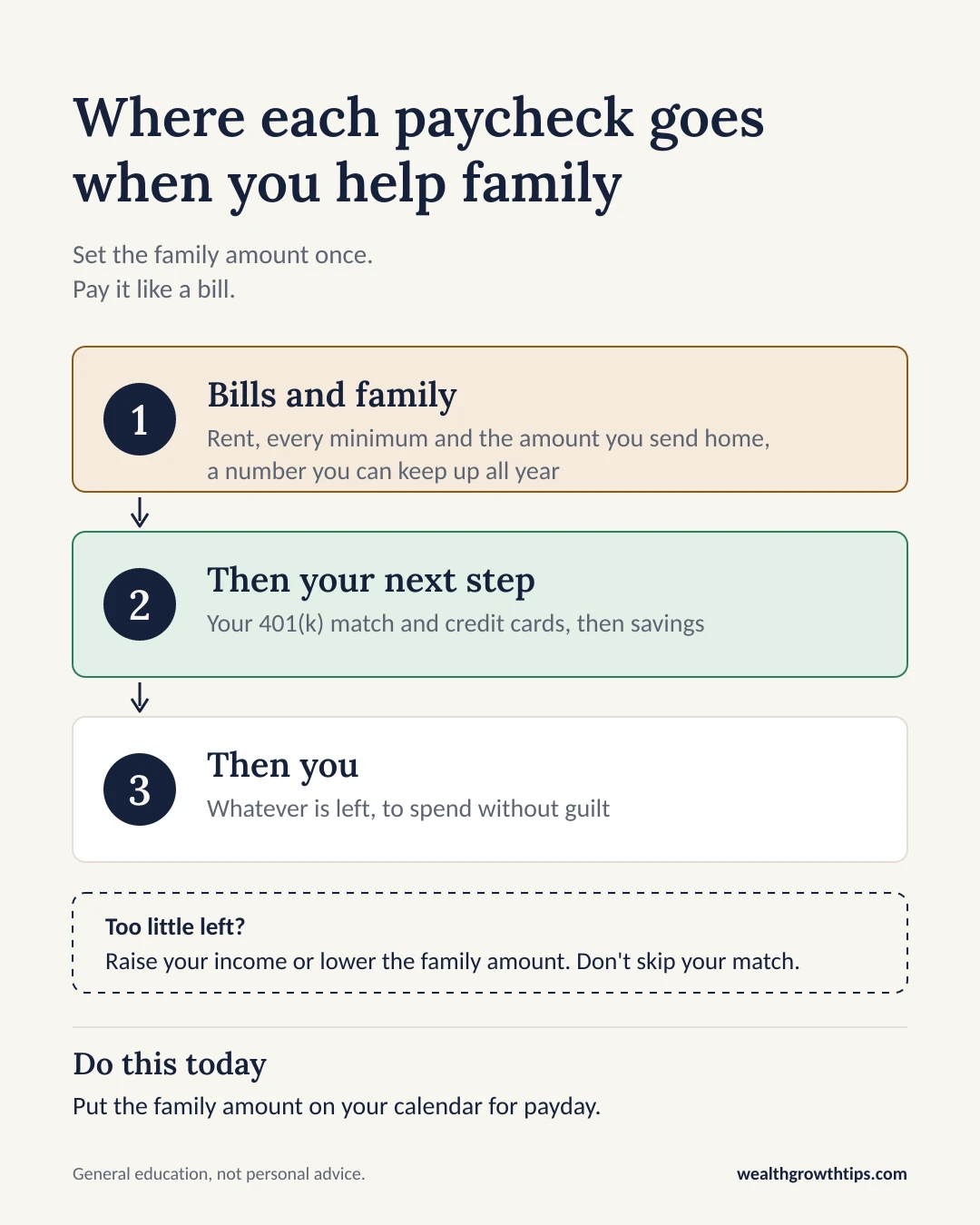
The family amount goes with your bills because it works like one, as what to do with extra money after paying your bills explains.
Your 401(k), the retirement account you get through work, is the one exception to this order. That money comes out of your paycheck before it reaches your bank. Set your rate once, high enough to get your employer’s full match, the money it adds when you put in part of your pay. After that, it takes care of itself. That’s why the family amount has to pass the one-year test. Of the money that reaches your bank, it goes out first, so it has to leave room for your next step.
To find a number that fits, use the send-home calculator. It suggests a monthly family amount you can maintain while still taking your next step, plus a short script for saying it out loud.
If what’s left feels too tight, don’t fix it by dropping your 401(k) match. Raise your income, or talk with your family about a smaller amount for now. The raise script builder can help you ask for more pay.
What a month looks like when the order runs itself
- Payday: your 401(k) money has already come out of your paycheck, so your match is handled. Rent, your other bills and the family amount go out on autopay or scheduled transfers. Then the extra payment goes to your highest-rate card. You don’t have to decide anything.
- Mid-month: your brother asks for help with his phone bill. It’s above your number, so you choose: cover it from what’s left, cover part of it, or say “not this month.” Your bills, the family amount and your card payment stay the same either way.
- Next payday: it all runs again, with nothing to decide.
That’s the payoff. Your family gets help they can count on, and helping stops coming out of your future by accident.
Say the number out loud once, so your family can plan too
The hardest part is one conversation: telling your parents (or whoever you’re helping), “This is what I can do each month.” You only need to have it once.
A number they know is a number they can plan around. They stop guessing what you can do, and you stop deciding from scratch every time your phone lights up.
Keep it short and warm. Something like: “I want to keep helping, and I want to be able to do it every month. Here’s what I can send, and it will come on payday.”
Why a real emergency should come from savings, not your 401(k)
Some requests can’t wait: your dad loses his job, and his rent is due Friday. Cover a real emergency like that from your emergency fund, not your retirement money. Then rebuild the fund.
Cashing out or borrowing from your 401(k) can be one of the most expensive ways to cover a family emergency. If you’re under 59½, money you cash out early usually counts as income and gets taxed, plus an extra 10% tax. And that money stops growing for your retirement.
What to do today
- Pick a family amount you could keep sending for a year. Write it where you’ll see it on payday.
- Schedule it to go out on payday, alongside your rent and other bills.
- Check that your 401(k) rate gets the full match. Then send your extra money to your highest-rate card. Any loan at 10% or more counts as a card here. Once they’re all paid off, send it to savings.
- Tell your family the number once, out loud.
More detail
What does “your next money step” mean?
It starts with two things. Get your full 401(k) match. Send every extra dollar to the credit card with the highest rate. When it’s paid off, move on to the next one. Other debt at 10% or more, such as a personal loan, counts as a card here. Once all of that is at zero, the same money goes into an emergency fund, your savings for surprises.
Why does the family amount come before my match and my cards?
Because your family counts on it, the way your landlord counts on rent. It’s set, not squeezed. You picked it to leave room for your match and your cards, and that’s what the one-year test checks. If it doesn’t leave room, the amount is too high.
Is borrowing from my 401(k) safer than cashing out?
It has its own risks. If you stop making the loan payments, what you still owe is treated as a withdrawal: taxed as income, and the extra 10% may apply. If you leave your job, your plan can require you to repay the whole balance.
Aren’t there exceptions to the extra 10% tax?
Yes, the IRS lists some. Most withdrawals are still taxed as income, though, and the money still stops growing for your retirement. Check the IRS list before you count on one.
What if I don’t have an emergency fund yet?
That’s normal while you’re paying off cards, since the fund comes right after them. Until then, a real emergency can come from the extra money you’ve been sending to your cards. Pause that extra payment for a month or two. Pay every minimum, as always. Once the cards are paid off, the emergency fund calculator shows when you’ll reach your target.
Should the amount ever change?
Yes, when your life does: a raise, a new job, a move, or a change in what your family needs. Look at it once a year. When it changes, say the new number out loud too.
You don’t have to understand all of this today. You just have to not quit.
The free 10-day email course walks through this and nine other things nobody in my family could tell me about money.
General education, not personal advice.
Sources (6)
- IRS: Topic no. 558, Additional tax on early distributions from retirement plans other than IRAs
- IRS: Retirement topics - Exceptions to tax on early distributions
- IRS: Matching contributions help you save more for retirement
- IRS: Retirement Topics Loans
- DOL: Top 10 Ways to Prepare for Retirement
- FINRA: Retirement Accounts
Was this helpful?
That didn't go through. Please try again in a minute.
Thanks. That helps me decide what to write next.
Thanks. I read every one of these.
Ask a question
General questions only. I can't give personal advice, so please don't include account numbers or personal details.
Thanks. I read every question. If you ticked the box, it may appear on this page without your name, with my answer.
Want a private reply? Email hello@wealthgrowthtips.com.