A birthday present for future you: your annual money checkup
Once a year, around your birthday, give your money one hour: a simple annual financial checkup of your pay, match, debt, credit, savings and investments.

Every year, your birthday comes around. Your pay changes. Your rent changes. The money choices you made on your first day at work usually stay right where you left them. Nobody taught me to check things like this growing up. I learned it on my own.
Checking just one of them can be worth $1,200 a year. Say you earn $60,000, and your employer adds a dollar for every dollar you put in, up to 5% of your pay. If you stop at 3%, you miss out on $1,200 of their money a year.
So here’s a birthday present for future you: one hour with your money, once a year. Below are the nine checks, what good looks like for each one, and what to do when something is off.
Why your birthday
It comes every year, and you never have to look up the date. It’s also a good time to start something. Researchers have found that people are more likely to work on their goals right after a date that feels like a fresh start, like a new year or a birthday. They call it the fresh start effect.
One exception: check your work benefits during your employer’s yearly window to pick them (open enrollment), even if it isn’t your birthday month.
Before you start
Set aside one hour. Put your phone on do not disturb. Keep what you find in one note titled with the year, such as “Money checkup 2026,” next to last year’s. Have these open:
- Your last pay stub
- Your 401(k) login
- Last year’s tax return
- A list of your accounts and debts (the net worth tool helps)
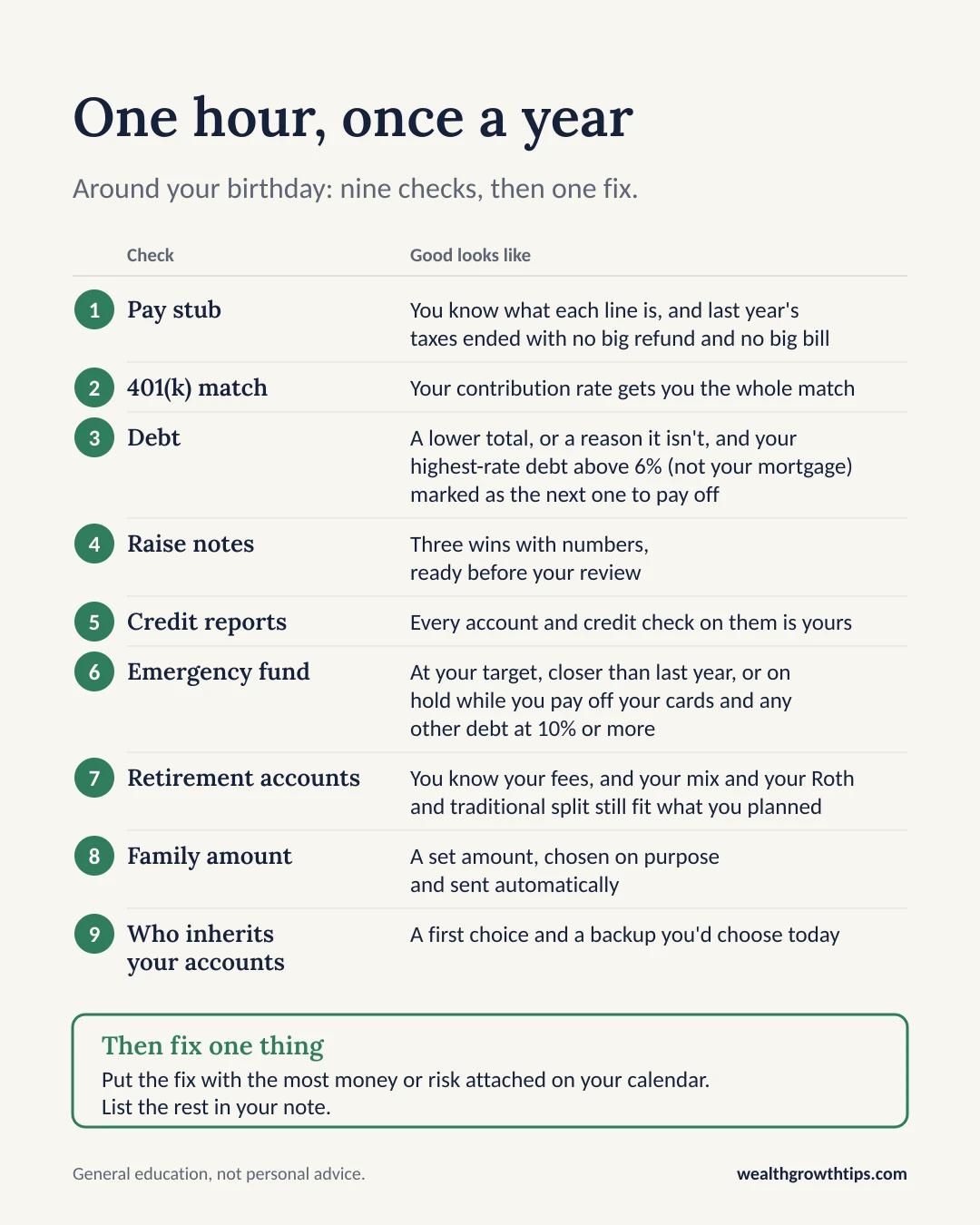
Your nine checks
“Good” tells you when to move on to the next check.
- Pay stub. Read every line, from your total pay (gross pay) to your take-home pay (net pay). Good: you know what each line is, and last year’s tax return ended with no big refund and no big bill. The first real paycheck guide shows how your total pay turns into take-home pay.
- 401(k) match. Look up how much of your pay you put in (your contribution rate) and your employer’s match. Good: that rate gets you the whole match. Try your numbers in the match calculator.
- Debt. List each debt with what you owe, its interest rate and its minimum payment. Good: a lower total than last year, or a reason it isn’t, and your highest-rate debt above 6% (not your mortgage) marked as the next one to pay off. See which debt to pay off first.
- Raise notes. Write down three wins from the past year, each with a number, like dollars saved or hours cut. Good: three wins, ready before your review. I review raise requests as part of my job, and a win with a number is easier to approve. How raises get decided has more.
- Credit. Get your free reports from Equifax, Experian and TransUnion at AnnualCreditReport.com. Good: every account and every credit check on them is yours. Building credit from zero has more.
- Emergency fund. Divide your emergency savings by your monthly essentials, like rent and food, to see how many months it covers. Good: at your target, closer than last year, or on hold while you pay off your cards and any other debt at 10% or more. The emergency fund guide shows how much to keep.
- Retirement accounts. Look up each fund’s yearly fee (the expense ratio). Small fees add up over time. Then compare your mix of stocks and bonds, and your split between Roth and traditional, with what you planned. Good: both still fit, and you know your fees. The three-fund portfolio and Roth vs traditional guides have more.
- Family amount. If you send money to family, compare this year’s total with your plan. Good: a set amount, chosen on purpose and sent automatically. The send-home calculator helps you set it.
- Who inherits your accounts. Check who you’ve named as your first choice and backup (the primary and contingent beneficiary) on each retirement account and life insurance policy. Good: both are people you’d choose today. If not, update them with your plan or insurer.
Then fix one thing
Fixes take longer than checks, so save them for after the hour. Pick the fix with the most money or risk attached. If it’s a money move, start with the first step you haven’t finished, as what to do with extra money after paying your bills explains. Put that fix on your calendar. List the rest at the bottom of your note.
If you’re on my email list, you’ll get a short note from me most weeks. Reply to any of them with a question your checkup turns up. I’ll do my best to get back to you within a week.
What to do today
- Put a one-hour event called “Money checkup” on your calendar for your birthday week. Set it to repeat every year.
- If your birthday is more than three months away, book a first checkup for this month too.
- Start this year’s note. Paste in the nine checks.
More detail
What if the tax taken from my pay (withholding) is off, or my life changes?
Too little can mean a bill, and maybe a penalty. Too much means smaller paychecks now and a bigger refund later. The IRS suggests checking your withholding every January, and after a big life change like a new job, a marriage or divorce, or a new child. Its Tax Withholding Estimator can fill out a new Form W-4 for you, the form that sets how much tax your employer takes out. The IRS says it takes about 25 minutes, so book that time separately.
How much can I put in this year?
For 2026, the most you can put into a 401(k) from your pay is $24,500, up from $23,500 for 2025. For a retirement account you open yourself (an IRA), it’s $7,500, up from $7,000. People 50 and older can put in extra, called catch-up contributions. IRAs allow it, and so do most 401(k) plans. The IRS adjusts these limits each year for the cost of living, so look them up on IRS.gov during your checkup. Late in the year, check whether next year’s are out.
What if a report has a mistake?
Contact the bureau and the business that reported it. Both have to fix it for free. You can also freeze your credit at each of the three bureaus. A freeze is free, doesn’t affect your score and lasts until you lift it.
Do I need more insurance?
If you rent, your landlord’s insurance generally won’t cover your belongings. Renters insurance can. If an illness or injury keeps you from working, disability insurance pays benefits to replace lost income. Check whether you have it through work. If someone depends on your income, look into term life insurance, which covers you for a set period of time.
Does my will decide who gets my retirement accounts and life insurance?
Usually not. FINRA, the Financial Industry Regulatory Authority, says retirement accounts and life insurance go straight to the people you named. Those names usually win over what your will says. They also usually stay in place through big life changes. If you’re married, a 401(k) typically has to name your spouse as primary beneficiary unless your spouse signs a waiver. FINRA’s planning guide goes deeper. For anything complicated, a lawyer or tax professional can help.
You don’t have to understand all of this today. You just have to not quit.
The free 10-day email course walks through this and nine other things nobody in my family could tell me about money.
General education, not personal advice.
Sources (14)
- Dai, Milkman and Riis: The Fresh Start Effect: Temporal Landmarks Motivate Aspirational Behavior (Management Science, 2014)
- IRS.gov: Tax Withholding Estimator
- IRS.gov: Tax withholding
- IRS.gov: 401(k) limit increases to $24,500 for 2026, IRA limit increases to $7,500
- IRS.gov: COLA increases for dollar limitations on benefits and contributions
- consumer.ftc.gov: Free Credit Reports
- consumer.ftc.gov: Credit Freezes and Fraud Alerts
- consumer.ftc.gov: Disputing Errors on Your Credit Reports
- Investor.gov: Expense Ratio
- Investor.gov: How Fees and Expenses Affect Your Investment Portfolio (Investor Bulletin)
- FINRA.org: Advance Planning for Your Investments
- Texas Department of Insurance: Renters insurance: What does it cover and how much does it cost?
- Texas Department of Insurance: Do you need life insurance?
- North Carolina Department of Insurance: Disability Income Insurance
Was this helpful?
That didn't go through. Please try again in a minute.
Thanks. That helps me decide what to write next.
Thanks. I read every one of these.
Ask a question
General questions only. I can't give personal advice, so please don't include account numbers or personal details.
Thanks. I read every question. If you ticked the box, it may appear on this page without your name, with my answer.
Want a private reply? Email hello@wealthgrowthtips.com.