How raises get decided, and how to find out what your job pays
How raise budgets work, what helps a raise request get approved, and free ways to look up what your job pays where you live.

You work hard, take on the problems nobody else wants, and trust that someone notices. Then the yearly review comes, and your pay barely moves. If nobody in your family worked in an office, you may never have heard that you can ask for more, or how.
The stakes are real: on $60,000 a year, a 5% raise is $3,000 more a year before taxes. Below, I’ll show you the schedule most employees never see, what I look for when I review raise requests as a chief financial officer, and a script for the conversation.
Raises usually follow a schedule most employees never see
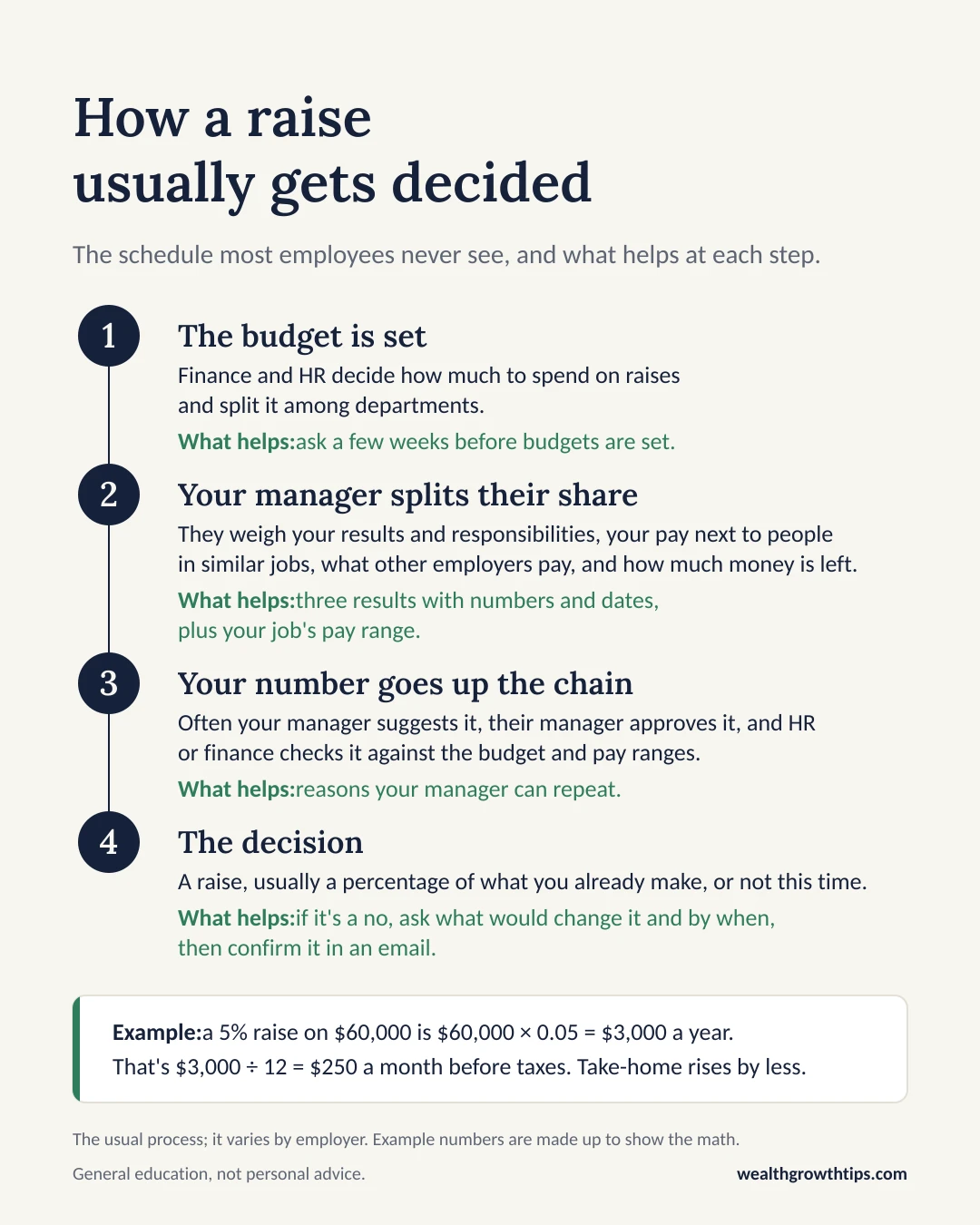
At many employers, raises are planned once a year, along with the budget. Finance and HR decide how much to spend on raises and split it among departments. Your manager’s share is often set before anyone hears a number.
When your manager splits their share, they usually weigh your results, your responsibilities, your pay compared with people in similar jobs, what other employers pay, and how much money is left.
Then your number goes up the chain. Often your manager suggests it, their manager approves it, and HR or finance checks it against the budget and the company’s pay ranges. Your raise gets explained to people who don’t see your work, so give your manager reasons they can repeat.
What helps a raise request get approved
When I review a raise request, specific beats general:
- Results with numbers and dates. For example, “cut invoice processing from 10 days to 6 between January and June” can be checked. “Improved our process” can’t.
- New work you’ve taken on. Duties, people you train, and clients or systems added since your pay was last set.
- What other employers pay. A pay range for your job in your area, with the source named.
- Timing. Ask before the budget is set, and your raise can be planned for. Ask after, and you compete for what’s left.
Effort matters. But long hours and years on the job don’t show what changed because of you. Higher rent and family needs are real too, but the person approving has to justify the raise with your work.
What a 5% raise is worth in your paycheck
Say you earn $60,000 and get a 5% raise. That’s $3,000 more a year, or $250 more a month, before taxes. Your take-home pay goes up by less, because taxes and other deductions come out first. The guide to your first real paycheck shows what comes out.
Yearly raises are usually a percentage of what you already make, so if you started low, they may never bring you up to what other employers pay.
My rule for raises: every time you get one, pretend you never had it. Put it toward your next step, as what to do with extra money after paying your bills explains. If you have credit card debt or other debt at 10% or more, your next step is paying it off. Either way, get your full 401(k) match. Once you’re past that debt, your emergency fund and any other debt above 6% (not your mortgage), your raise goes to building wealth, from an IRA all the way up to the max.
Find out what your job pays, for free
Government pay data. The U.S. Bureau of Labor Statistics publishes free pay data called Occupational Employment and Wage Statistics (OEWS). It covers about 830 kinds of jobs, for the whole country, each state, and about 530 smaller areas, from big cities to small towns and rural areas.
Picture everyone in your job lined up from lowest pay to highest. OEWS shows the pay at five spots: 10, 25, 50, 75 and 90 percent of the way up the line. Half the people stand between the 25 and 75 spots, and the middle one is the median.
The newest figures came out May 15, 2026, and show pay in May 2025. They leave out overtime and some bonuses, such as year-end bonuses, so don’t count those when you compare. Match on what you do, not just your title.
Job postings. More and more states require many employers to list the pay, or a pay range, in job postings.
Your coworkers. Under the National Labor Relations Act, most employees who don’t work for the government have the right to talk about pay with coworkers. If you’re covered, your employer can’t punish you for it or ban it with a rule. If asking feels rude, share your own pay first.
Ask a few weeks early, with one page and a script
Ask your manager for a meeting about pay, in person or on video, a few weeks before budgets are set. Say what it’s about when you book it, so they have time to prepare.
Bring one page with your results, new work and pay range. Here’s a sample script:
“Thanks for making time. I’d like to talk about my pay. This year I [result], [result] and [result]. I’ve also taken on [new responsibility]. The range I found for this job in our area is [low] to [high], from [source], and I’m at [your pay]. I’m asking to move to [number]. What would it take to get there this round?”
If the answer is no, ask what you’d need to show to change it, and by when. Then confirm it in a short email the same day: “Thanks for today. To confirm, if I [goal] by [date], we’ll look at my pay again in [month].” Your manager can show that to their bosses, and you have a date to come back to.
What to do today
- Ask HR or your manager when raises are decided where you work, so you can book your meeting a few weeks before.
- Look up your job in the OEWS pay data for your state or local area. Save a few job postings that show pay.
- Pick your three strongest results from the past year. Add a number and a date to each. Then draft your script with the raise script tool.
More detail
Which states require pay in job postings?
As of October 2026, the list includes California, Colorado, Connecticut, Hawaii, Illinois, Maine, Maryland, Massachusetts, Minnesota, New Jersey, New York, Vermont, Virginia and Washington. Washington, D.C., requires it too. Which employers are covered depends on the state, often on how many employees they have.
Can I get the pay range for my own job from my employer?
In California, if you ask, your employer must give you the pay scale for your current job (Labor Code section 432.3). That’s the range it reasonably expects to pay someone it hires for that job. In Connecticut, Maine and Massachusetts, current employees can also ask for the pay range for their job. In Massachusetts, that’s only at employers with 25 or more employees.
What if I’m a government worker, supervisor or contractor?
Not every workplace plans raises from a yearly budget. Some government jobs follow a pay scale with set steps. The right to talk about pay with coworkers also has limits: government workers, supervisors and independent contractors are among those that federal law doesn’t cover.
What if the budget is tight?
Ask for what costs less now and sets up your next raise: a new title, a project that’s yours to run, training, or a pay review before the next round.
Should I look at other jobs?
If you’ve asked, done what was asked, and the answer is still no, an outside offer shows what other employers will pay you today. And looking doesn’t make you disloyal. The Federal Reserve Bank of Atlanta tracks how much the typical worker’s hourly pay went up over the past 12 months. In September 2026, it was 4.7% for people who changed jobs and 3.4% for people who stayed. Only show your manager an offer you’d really take. If they don’t match it, you need to be ready to go.
What should I check before I leave a job?
Check when your 401(k) match, the money your employer adds to your retirement savings, becomes yours to keep. Plans call this vesting. What you put in from your paycheck is always 100% yours. The match may be yours right away, or it may take several years of work, so leaving just before a vesting date can cost you some or all of it. Compare whole offers, not just salary. And plan how you’d pay your bills if your start date gets pushed back.
You don’t have to understand all of this today. You just have to not quit.
The free 10-day email course walks through this and nine other things nobody in my family could tell me about money.
General education, not personal advice.
Sources (29)
- BLS: Occupational Employment and Wage Statistics
- BLS: Occupational Employment and Wages Summary, May 2025
- BLS: OEWS Frequently Asked Questions
- BLS: Percentile Wages
- OPM: General Schedule
- California Labor Commissioner’s Office: California Equal Pay Act and Pay Transparency Law, Frequently Asked Questions
- Colorado Department of Labor and Employment: Equal Pay for Equal Work Act
- Hawaii Civil Rights Commission: New Hawaii law regarding pay transparency and equal pay (FAQ)
- Illinois Department of Labor: Equal Pay Act Salary Transparency
- Maine Department of Labor: New Maine Labor Laws Strengthen Workplace Protections, Promote Compliance, and Support Maine’s Workforce
- Maryland Department of Labor: Wage Range Transparency Frequently Asked Questions
- Mass.gov: Pay Transparency in Massachusetts
- Minnesota Office of the Revisor of Statutes: Section 181.173, Salary ranges required in job postings
- New Jersey Department of Labor and Workforce Development: My Work Rights, New Jersey pay and benefits transparency law
- New York State Department of Labor: Pay Transparency
- Vermont Workplaces for All: Pay ranges in job advertisements
- Virginia Department of Labor and Industry: Employment Law Updates: New Legislation Protecting Virginia Workers Applies Beginning July 1, 2026
- Washington Department of Labor and Industries: Equal Pay and Opportunities Act
- NLRB: Your Right to Discuss Wages
- NLRB: Introduction to the NLRB
- NLRB: Are You Covered?
- Federal Reserve Bank of Atlanta: Wage Growth Tracker
- IRS: Retirement topics: Vesting
- Connecticut General Assembly: Public Act 26-12 (Substitute House Bill 5003), section 2
- D.C. Law 25-138, Wage Transparency Omnibus Amendment Act of 2023
- BLS: OEWS area definitions
- USDA Economic Research Service: What is Rural?
- WorldatWork: QuickPulse report shows salary stability carrying over into 2027 (Sept 1, 2026)
- WorldatWork: Payscale: economic gains will push 2027 salary budgets higher (Aug 6, 2026)
Was this helpful?
That didn't go through. Please try again in a minute.
Thanks. That helps me decide what to write next.
Thanks. I read every one of these.
Ask a question
General questions only. I can't give personal advice, so please don't include account numbers or personal details.
Thanks. I read every question. If you ticked the box, it may appear on this page without your name, with my answer.
Want a private reply? Email hello@wealthgrowthtips.com.