What a 401(k) match is, with real numbers
How a 401(k) match works, in plain words: find where your match stops growing, put in at least that much, and check when it becomes yours.

Your first week at a new job came with a stack of forms. You signed where HR pointed, left the boxes the way you found them and got back to work. Nobody at home had ever told you which of those boxes mattered.
One of those boxes can start you toward a million dollars. Say that from age 25 to 65, 40 years in all, you put $500 a month into low-cost funds that spread your money across many stocks or bonds at once, called index funds. If it grows 6% a year on average, which isn’t guaranteed, you’d have about $1 million.
Only $240,000 of that would be money you put in. The rest is growth: your money earns money, and then those earnings earn money too.
That assumes two things: you keep investing every month, even when the market drops, and the market doesn’t crash and stay down for a decade or two. That can happen, so treat the million as an example, not a promise.
If your employer offers a match on your 401(k), the retirement account you save in through work, collecting every dollar of it is the first step toward that million. For how to invest the money, I’d point most people to a three-fund mix of those low-cost funds, Bogleheads style, held for decades.
Below: an example plan worked out percent by percent, why the match comes before any investing choice, and the longest your employer can make you wait to own it.
Why the default can leave part of the match unclaimed
Right out of undergrad, someone at lunch asked me what my match was. I didn’t know, so I went and found out. I was putting in 2% of my pay because that was the default, and my employer matched up to 6%.
The match is money your employer adds to your 401(k) when you put in some of your own pay, up to a cap written into the plan.
The default is the rate the plan uses if you never choose one, a starting point someone else picked. It can sit below the point where your match stops growing. To know for sure, read your plan’s formula. The guide to your first real paycheck explains the lines on your pay stub, including your 401(k).
In the example plan, putting in 5% gets you the full match
Plans describe the match in one dense sentence. Say yours reads “100% of the first 3%, then 50% of the next 2%.” In plain words: your employer adds a dollar for each dollar you put in, up to 3% of your pay, then half a dollar for each dollar on the next 2%.
Here’s what goes in at each level, as a share of your pay:
- You put in 0%: your employer adds 0%.
- You put in 3%: your employer adds 3%, so 6% goes in.
- You put in 5%: your employer adds 4%, so 9% goes in. That’s the full match.
- You put in 6%: your employer still adds 4%, so 10% goes in.
- You put in 10%: your employer still adds 4%, so 14% goes in.
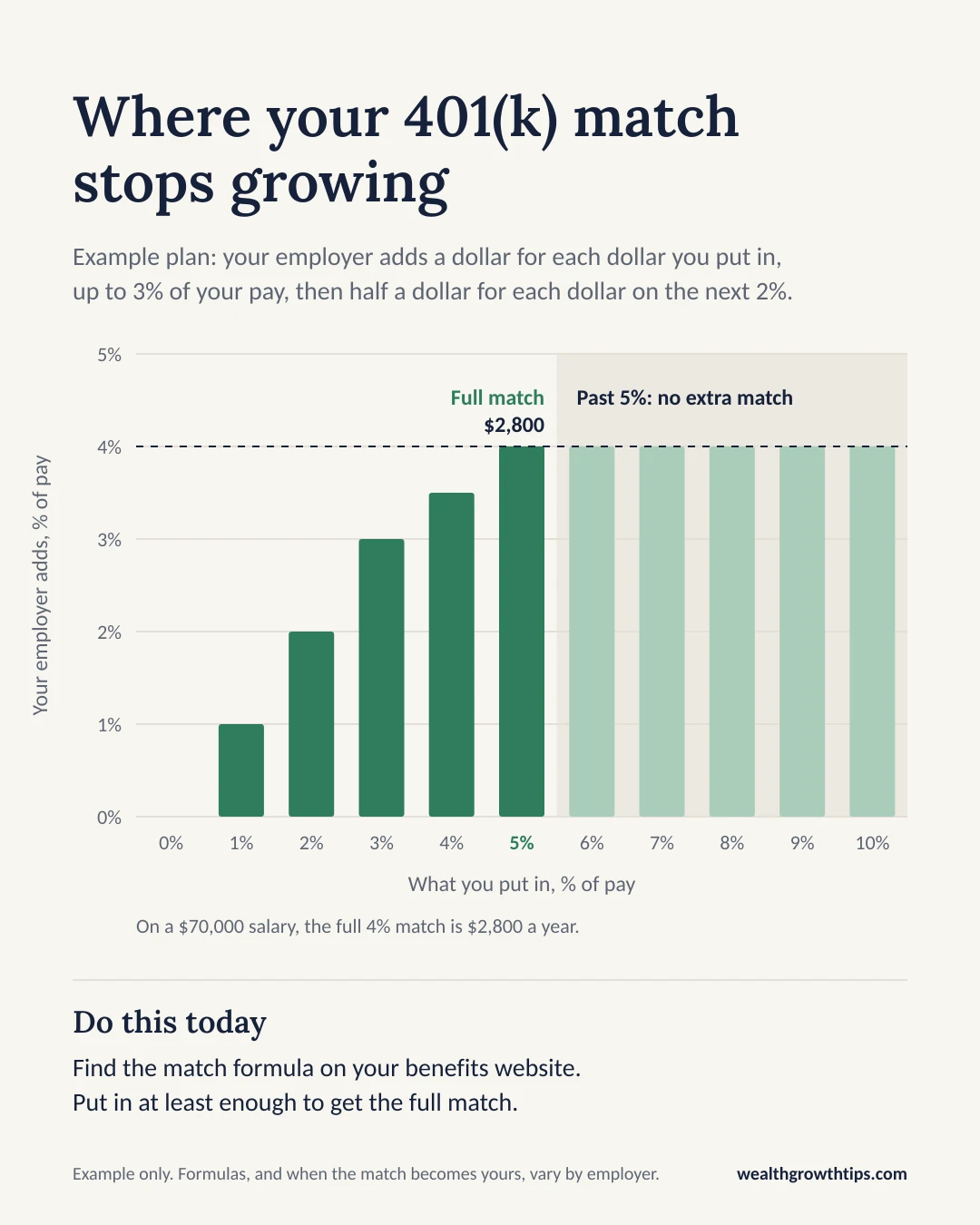
On a $70,000 salary, that full 4% match is $2,800 a year. Put in less than 5% and you leave some of it behind. Put in more and you’re saving more of your own money, but your employer adds nothing extra. Have credit card debt? Still get the full match while you pay it off. Money beyond the match goes to the cards first, as what to do with extra money after paying your bills explains.
Why the match comes before any investing choice
With a 100% match, each dollar you put in arrives with a second dollar from your employer. Your money doubles before it has earned a cent, once the match is yours to keep. Even the 50% part adds half a dollar to every dollar.
Compare that with the 6% a year in the million example, which is only an average and isn’t guaranteed.
Putting in less does leave a little more in each paycheck. But below the match point, every dollar you keep also turns down a dollar or half a dollar from your employer. So get the full match first. Then choose what it’s invested in.
Your match can take up to 6 years of service to become yours
Everything you put in from your paycheck is 100% yours from day one. The match can come with a wait, which plans call vesting: when your employer’s money becomes yours to keep.
Under IRS rules, the wait has limits. A plan can make you wait up to 3 years of service and then give you all of the match at once. Or it can give you a bigger share each year of service, with all of it yours after no more than 6 years of service.
If you leave before then, you can lose the part of the match that isn’t yours yet. So look up your plan’s vesting schedule before you plan to leave a job. Sometimes staying three more months is worth thousands of dollars.
What to do today
- Open the 401(k) section of your benefits website. Copy down the match formula word for word.
- Work out the percent of pay where your match stops growing. Then set your 401(k) to at least that percent. The 401(k) match calculator can check your numbers.
- Find the vesting schedule. Write down the date the match becomes fully yours.
All three take about ten minutes.
More detail
What if my plan’s formula is worded differently?
The steps don’t change. Find the percent of your pay where your employer stops adding more. Put in at least that. If the wording still doesn’t make sense, ask HR for that one number.
What do “all at once” and “a bigger share each year” mean?
All at once, often called cliff vesting, means you own none of the match until you finish a set number of years of service, no more than 3, and then you own all of it. A bigger share each year, or graded vesting, means your share grows as your years of service add up, until you own all of it after no more than 6. Your plan sets how it counts a year of service, generally 1,000 hours of work in 12 months.
How can a few months be worth thousands?
Under an all-at-once schedule, none of the match is yours until you finish the set number of years of service, up to 3. In the example above, a full year of match is $2,800, and every year of it waits until you get there.
What if I can’t afford to put in enough for the full match yet?
Start with what you can. Raise the percent you put in each time your pay goes up, until you reach the match point. Each step up brings more of your employer’s money with it.
Will $1 million be worth as much in 40 years?
Probably not. Prices tend to rise over time, so a million dollars then will likely buy less than a million buys today. That’s one more reason to start early and to raise what you save over time.
You don’t have to understand all of this today. You just have to not quit.
The free 10-day email course walks through this and nine other things nobody in my family could tell me about money.
General education, not personal advice.
Was this helpful?
That didn't go through. Please try again in a minute.
Thanks. That helps me decide what to write next.
Thanks. I read every one of these.
Ask a question
General questions only. I can't give personal advice, so please don't include account numbers or personal details.
Thanks. I read every question. If you ticked the box, it may appear on this page without your name, with my answer.
Want a private reply? Email hello@wealthgrowthtips.com.