The Bogleheads three-fund portfolio: investing with three index funds
How the Bogleheads three-fund portfolio works, what Warren Buffett's bet against hedge funds showed, what fees cost, and how to pick your stock and bond mix.

You cover rent and bills, and some money is left each month. A coworker swears by a hot tip, a relative says it’s all gambling, and nobody you know can tell you where to start.
Say you put $500 a month into low-cost index funds for 40 years, from age 25 to 65. If it grows 6% a year on average, which isn’t guaranteed, you’d have about $1 million. Only $240,000 of it is money you put in; the rest is growth on top of growth.
That assumes two things: you keep investing every month, even when prices fall, and the market doesn’t stay down for a decade or two. Treat the million as an example, not a promise.
To get there, I’d point most people to the Bogleheads three-fund portfolio: three low-cost index funds, held for decades. Got credit card debt? Pay it off before you invest more than your 401(k) match.
Below, I’ll cover Warren Buffett’s bet against hedge funds, what a fee you never see costs, a mix you won’t sell in a crash, and how to set it up in your 401(k).
Three funds can spread your money across thousands of companies
Gambling is a bet on one outcome, like putting all your savings in one company’s stock. An index fund does the opposite: it tries to match a market index, like the S&P 500, instead of paying managers to pick stocks. That can cost less, but not every index fund is cheap.
Paying for stock picking usually hasn’t paid off. S&P keeps score on this. Over the 20 years to June 30, 2026, 92.61% of large-company U.S. stock funds run by stock pickers did worse than the S&P 500.
Hedge funds, private funds for wealthy investors, did no better in Buffett’s bet. He bet that an S&P 500 index fund would beat five groups of hedge funds picked by a hedge fund firm. From 2008 through 2017, his index fund gained 125.8%. Theirs gained between 2.8% and 87.7%. In 2013, he wrote that his will tells the person who’ll manage his wife’s inheritance to put 90% in a very low-cost S&P 500 index fund and 10% in short-term government bonds.
Many Bogleheads, a community of investors who favor broad index funds, low costs and sticking with a plan, hold just three:
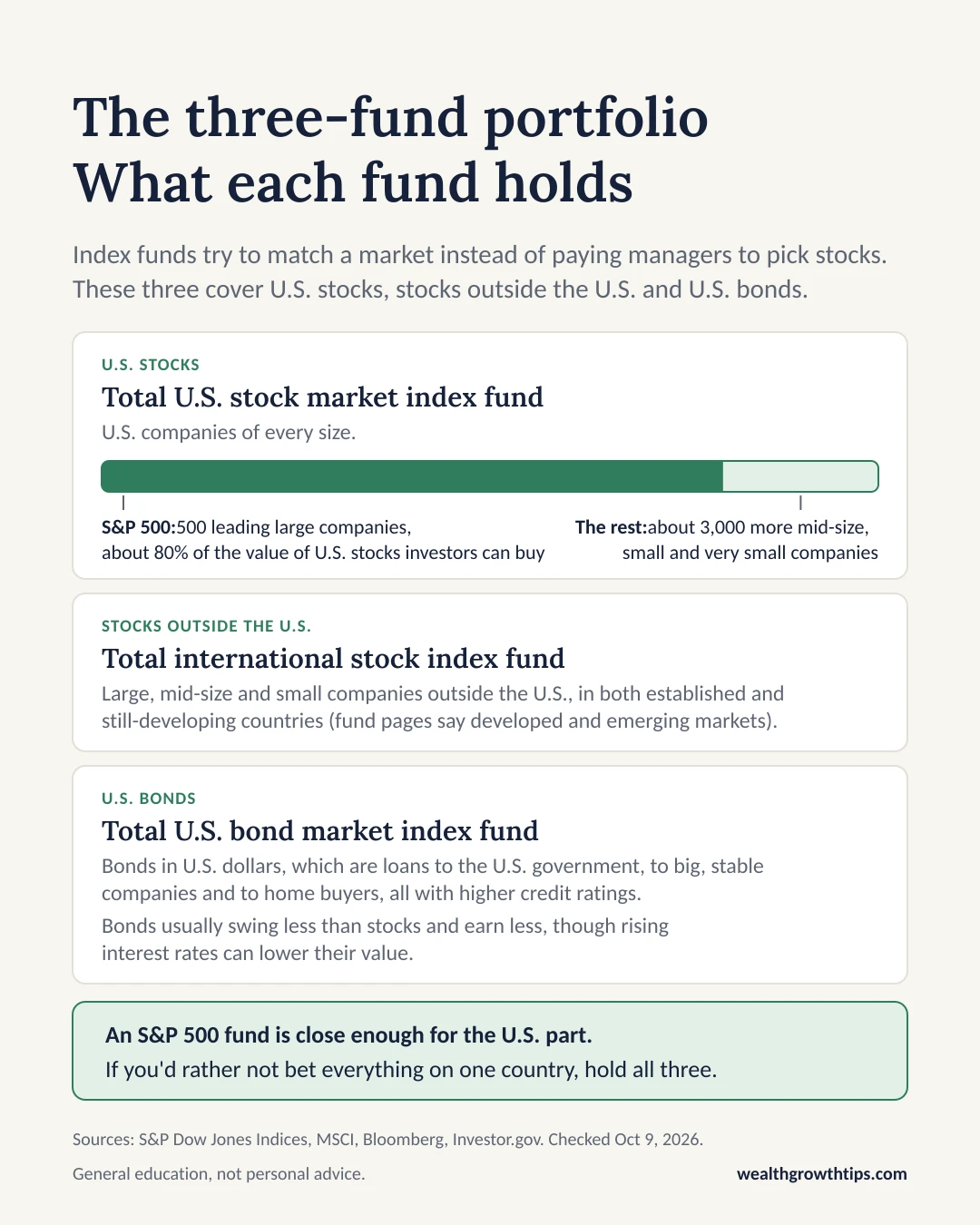
- Total U.S. stock market index fund: U.S. companies of every size.
- Total international stock index fund: large, mid-size and small companies outside the U.S., in both established and still-developing countries (fund pages say developed and emerging markets). One such index held 5,854 stocks on Sept. 30, 2026.
- Total U.S. bond market index fund: bonds in U.S. dollars, which are loans to the U.S. government, to big, stable companies and to home buyers, all with higher credit ratings.
A fee you never see can cost you more than $13,000
Funds charge a yearly fee for their running costs, taken from your returns.
Say you invest $10,000 once and leave it for 30 years, growing 6% a year before fees.
- Fund A charges 0.05%, about $5 a year on $10,000, so you keep 5.95% a year and end with $56,627.69.
- Fund B charges 1.00%, about $100 a year on $10,000, so you keep 5.00% a year and end with $43,219.42.
The higher fee leaves you $13,408.27 behind, about 24% less, because every dollar a fee takes stops growing for you. The 6% is an assumption, not a forecast.
Pick a mix you could hold through a 57% drop
Of the main types of investments, stocks have had the highest returns over time, and the biggest swings. Bonds usually swing less and earn less, though rising interest rates can lower their value.
Your mix depends on when you need the money (your time horizon) and how big a loss you can accept for higher potential returns (your risk tolerance). Here are two example mixes. They’re illustrations, not recommendations:
- Example A (decades away, able to sit through deep drops): 90% stocks and 10% bonds, such as 60% total U.S. stock, 30% total international stock and 10% total bond.
- Example B (closer to needing the money): 60% stocks and 40% bonds, such as 40% U.S. stock, 20% international stock and 40% bond.
Big drops have happened several times and can happen again: the S&P 500 fell 57% from October 2007 to March 2009. Owning thousands of companies doesn’t stop a market-wide fall, and funds at a broker aren’t insured against losing value.
Selling below what you paid turns a drop into a real loss, and selling to dodge a drop means guessing right twice: when to get out and when to get back in. So test your mix: could you hold it through a drop like 2007 to 2009 without selling? If not, more bonds may fit better.
Money you’ll need soon, like an emergency fund, belongs where it won’t fall with the market.
Build it from what your 401(k) offers
First, get your full employer match. The 401(k) match guide shows how. Before you invest more than the match, pay off your credit cards and any other debt at 10% or more. Then build your emergency fund. After that, pay down any debt above 6% except your mortgage, as what to do with extra money after paying your bills explains.
You’re limited to your plan’s fund list, which may not have all three, so look for the closest index options.
Or use one target-date fund. It’s a mix of funds, and the manager usually shifts it toward bonds as the year in its name gets closer. That year is when you expect to retire. Funds with the same year can be very different, and none of them guarantees you’ll have enough income. So compare costs, including the costs of the funds inside.
Beyond your 401(k), an IRA is a retirement account you open yourself, at a brokerage such as Fidelity, Schwab or Vanguard. I use all three, and none of them pays this site anything. The Roth vs traditional guide covers which type to pick.
What to do today
- Log in to your 401(k). Open your investment choices or the yearly fee disclosure.
- List what you hold, the plan’s index funds (total U.S. or S&P 500, international, bond) and its target-date funds, each with its expense ratio.
- Compare their fees. Then pick three funds, or one target-date fund. Not getting the full match yet? Start with the 401(k) match calculator.
More detail
Will $1 million be worth as much in 40 years?
No. Prices rise over time, so a million then will buy less than a million buys today. That’s one more reason to start early and raise what you save.
Is an S&P 500 fund close enough?
For the U.S. part, it’s close. The S&P 500 holds 500 leading large U.S. companies, about 80% of the value of U.S. stocks investors can buy. S&P’s total market index adds about 3,000 more mid-size, small and very small companies. It’s what I own: an S&P 500 fund and a bond fund, with no international fund, because I believe big companies are global now. John Bogle, who founded Vanguard, made the same case and said not to go over 20% in international. Both example mixes on this page hold at least that much. His cap is one view, not a rule. The risk is that they’re still U.S. stocks. From 2000 through 2009, the S&P 500 lost 0.95% a year on average. If you’d rather not bet everything on one country, hold all three.
How do I reset my mix?
Once a year, in your annual money checkup, move money around to get back to the mix you picked. Plan websites call this rebalancing. Say you follow Example B with $10,000: $6,000 in stocks and $4,000 in bonds. If stocks grow to $8,000, they’re two-thirds of your $12,000. Moving $800 to bonds puts you back at 60% and 40%. In a regular brokerage account, putting new money into what lagged avoids selling, so there’s no profit to tax.
When are gains taxed?
In a traditional (pre-tax) 401(k) or IRA, gains generally aren’t taxed until you withdraw, and Roth accounts have their own rules. In a regular brokerage account, if you buy shares for $1,000 and sell for $1,500, that $500 profit is a capital gain. If you held the shares more than a year, the tax rate depends on your income, and it can be 0%. If you held them a year or less, the gain is taxed like your regular income.
Which funds, exactly?
In a 401(k), use the closest index funds your plan offers. Anywhere else, any low-cost total market fund works. Here are some examples, not recommendations. Each one is an index fund that trades like a stock (an ETF), with its yearly fee as of Oct. 7, 2026:
- Total U.S. stock: Vanguard VTI, iShares ITOT or Schwab SCHB, each 0.03%
- Total international stock: Vanguard VXUS, 0.05%, or iShares IXUS, 0.07%
- Total U.S. bond: Vanguard BND, iShares AGG or Schwab SCHZ, each 0.03%
- S&P 500: Vanguard VOO or iShares IVV, each 0.03%
Names and fees change, so check the fund’s own page first.
What else should I skip?
Don’t put money you need into one company’s stock. If the company goes bankrupt, its stockholders may get nothing. Don’t borrow from your brokerage to invest (buying on margin), because you can lose more than you put in. And don’t hold too much of your employer’s stock, since your job and your savings could fall at the same time. FINRA says some experts suggest no more than 10% in any one stock, your employer’s included, and that even that could be too high.
You don’t have to understand all of this today. You just have to not quit.
The free 10-day email course walks through this and nine other things nobody in my family could tell me about money.
General education, not personal advice.
Sources (48)
- Bogleheads wiki: Bogleheads investment philosophy
- Investor.gov: Investor Bulletin: Index Funds
- S&P Dow Jones Indices: SPIVA U.S. Scorecard Mid-Year 2026 (PDF)
- S&P Dow Jones Indices: SPIVA U.S. Mid-Year 2026
- S&P Dow Jones Indices: S&P 500
- S&P Dow Jones Indices: S&P Total Market Index (TMI)
- S&P Dow Jones Indices: S&P Completion Index
- MSCI: MSCI ACWI ex USA IMI Index
- Bloomberg: Bloomberg US Agg Total Return Value Unhedged USD
- Investor.gov: Bonds FAQs
- Investor.gov: Expense Ratio
- U.S. Department of Labor: A Look at 401(k) Plan Fees (PDF)
- Investor.gov: Beginners’ Guide to Asset Allocation, Diversification, and Rebalancing
- Investor.gov: Target Date Funds: Investor Bulletin
- IRS: Publication 590-A (2025), Contributions to Individual Retirement Arrangements (IRAs)
- IRS: 401(k) Resource Guide, Plan Participants, 401(k) Plan Overview
- IRS: Traditional IRAs
- IRS: Topic no. 409, Capital gains and losses
- Federal Reserve History: The Great Recession
- Federal Reserve History: Stock Market Crash of 1987
- Federal Reserve History: Stock Market Crash of 1929
- Investor.gov: What is Risk?
- Investor.gov: Stocks FAQs
- Investor.gov: Margin Account
- Investor.gov: Investor Bulletin: Understanding Margin Accounts
- FINRA: Love Your Company Stock? Here’s What to Know.
- Investor.gov: Hedge Funds
- Berkshire Hathaway: 2017 letter to shareholders (PDF)
- Berkshire Hathaway: 2016 letter to shareholders (PDF)
- Berkshire Hathaway: 2013 letter to shareholders (PDF)
- InvestmentNews: John Bogle says investors don’t need to own international stocks
- Vanguard: Vanguard’s history
- Dimensional: A Tale of Two Decades
- Investor.gov: Exchange-Traded Funds (ETFs)
- iShares: Core S&P Total U.S. Stock Market ETF (ITOT)
- iShares: Core MSCI Total International Stock ETF (IXUS)
- iShares: Core U.S. Aggregate Bond ETF (AGG)
- iShares: Core S&P 500 ETF (IVV)
- Schwab Asset Management: Schwab U.S. Broad Market ETF (SCHB)
- Schwab Asset Management: Schwab U.S. Aggregate Bond ETF (SCHZ)
- Vanguard: Morningstar Total Stock Market ETF (VTI)
- Vanguard: Total International Stock ETF (VXUS)
- Vanguard: Total Bond Market ETF (BND)
- Vanguard: S&P 500 ETF (VOO)
- Vanguard: Vanguard to Update Names of U.S. Equity Index Funds Tracking Morningstar Indexes (Apr. 29, 2026)
- Federal Reserve: What is inflation, and how does the Federal Reserve evaluate changes in the rate of inflation?
- Morningstar: Bogle: Why I Don’t Invest Overseas (Oct 22, 2010)
- Berkshire Hathaway: 2013 shareholder letter
Was this helpful?
That didn't go through. Please try again in a minute.
Thanks. That helps me decide what to write next.
Thanks. I read every one of these.
Ask a question
General questions only. I can't give personal advice, so please don't include account numbers or personal details.
Thanks. I read every question. If you ticked the box, it may appear on this page without your name, with my answer.
Want a private reply? Email hello@wealthgrowthtips.com.