Credit from zero: how to build a score when nobody can co-sign
How to build a credit score from nothing with no co-signer: what the score measures, a one-card setup, how long it takes, and the mistakes that cost the most.

You’re ready for your first apartment or your first car, and someone asks who can sign with you. Nobody in your family can. You’ve paid every bill you’ve ever had, but there’s nothing on paper that shows it.
One card in your own name, paid in full every month, can give you a credit score in six months. I opened my first card without a co-signer, someone who signs with you and promises to pay if you don’t. And it was a regular card, not one that needs a cash deposit first (a secured card).
Below, I’ll walk you through what the score counts, how paying early can help, and the four mistakes that cost the most.
Two habits make up about two-thirds of the score
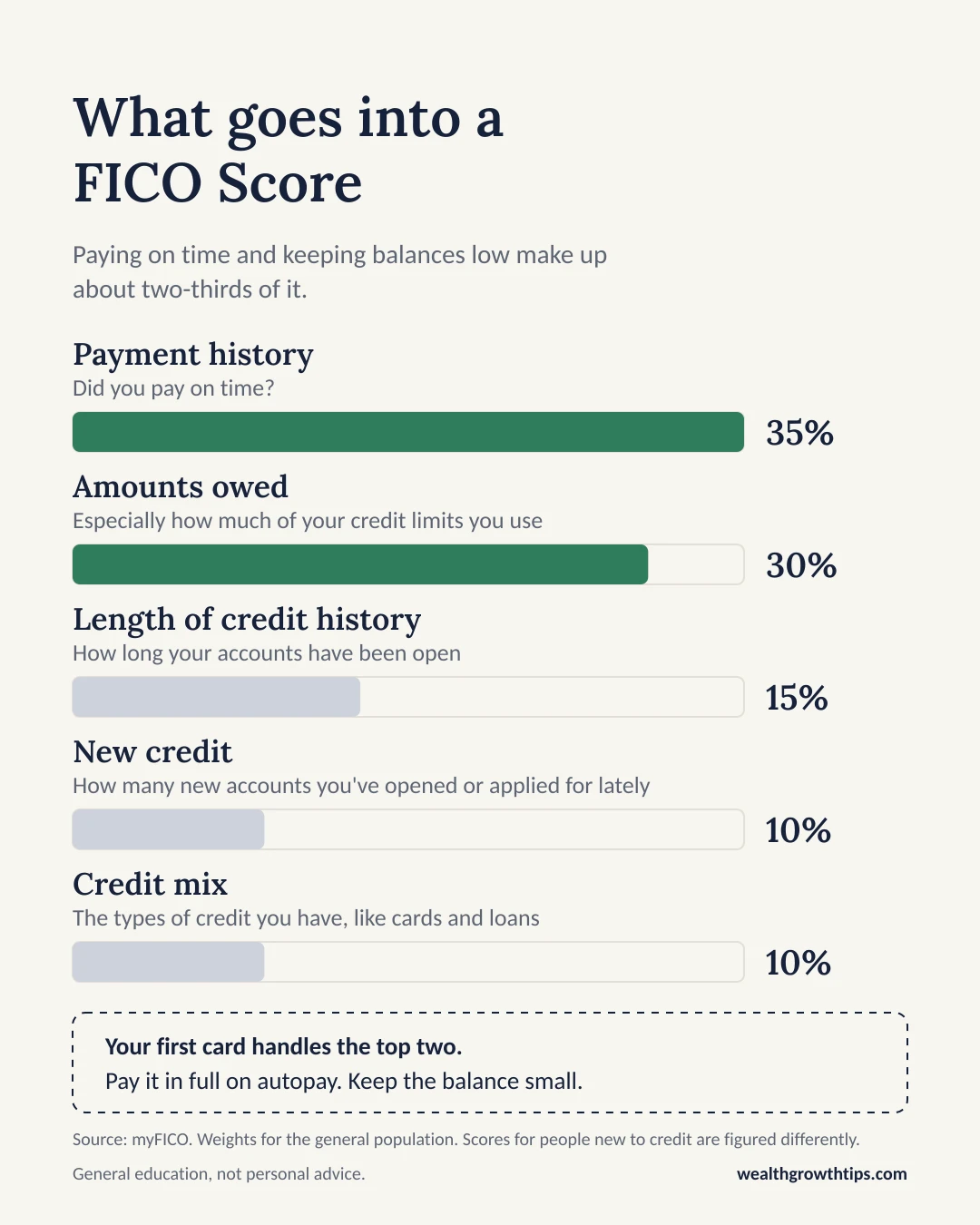
When you apply for a card or a car loan, the lender checks your credit score, a number it uses to judge how likely you are to pay back what you borrow. The score comes from your credit report, the record of your cards and loans and how you’ve paid them. The FICO Score is built from five parts of your report, and in general they count like this:
- Paying on time (payment history): 35%
- How much you owe, especially how much of your credit limits you’re using (amounts owed): 30%
- How long your accounts have been open (length of credit history): 15%
- How many new accounts you’ve opened or applied for lately (new credit): 10%
- The kinds of credit you have, such as cards and loans (credit mix): 10%
The first two parts, paying on time and keeping what you owe low, make up about two-thirds of the score. Your salary, your job and your employer aren’t part of it. FICO says these shares are for people in general. If you’re new to credit, your score is figured differently.
One card and one bill are enough to start
- Apply for one card in your own name. Look for one with no yearly fee just for having it (an annual fee). Check that the card company reports to all three credit bureaus, the companies that keep credit reports: Equifax, Experian and TransUnion.
- Put one bill you already pay every month on the card, such as your phone or streaming bill.
- Set up automatic payment for the full amount of each monthly card bill. Card companies call this the statement balance. That takes care of paying on time, the biggest part of the score. On most cards, it also means you won’t pay interest on what you buy.
- After that, the main job is patience. To get a FICO Score, you need at least one account that’s been open six months or more. You also need at least one account that a lender has reported to a credit bureau in the past six months. So if this card is your first account, the soonest you can have a FICO Score is six months after you open it.
How paying early can turn 30% into 5%
Say your card has a $1,000 credit limit, the most you can owe on it. If you owe $300, you’re using 30% of your limit. If you owe $50, you’re using 5%.
The second-biggest part of the score looks at this number: how much of your credit limit you’re using. Credit apps call it credit utilization. To get it, divide what you owe by your limit.
Now say you owe $300, and you pay it down to $50 before the day the card company adds up your monthly bill. That day is called the statement closing date. Card companies usually report the balance on your statement. So the balance they report would be $50, which is 5% of your limit instead of 30%.
You’ll hear “stay under 30%.” That’s a rough guide. There’s no exact point where your number goes from good to bad, and lower is better. In Experian’s data, people with scores of 800 or higher use about 7% of their limits on average.
The four mistakes that cost the most
- Leaving part of your bill unpaid to build credit, which people call carrying a balance. You don’t need to carry a balance to get a good score, and every month you carry one costs you interest. If you already carry one, paying it off comes after your basics, like rent and food, as what to do with extra money after paying your bills explains. If your employer matches your 401(k), get the full match first. Which debt to pay off first shows the order.
- Missing a payment. A payment that’s 30 days late can be reported to the credit bureaus and stay on your report for seven years. Automatic payment prevents most of these.
- Applying for several cards at once. Each application usually adds a note to your report saying a lender checked your credit. That note is called a hard inquiry. Hard inquiries stay on your report for up to two years, but FICO Scores only count the ones from the last 12 months.
- Closing your first card when you get a better one. A closed account with nothing past due can stay on your report for up to 10 years. But closing it cuts your total credit limit, which can raise how much of that limit you’re using.
What to do today
- Get your credit reports from all three bureaus at AnnualCreditReport.com. It’s free, and you can do it every week. Then check them again in your annual money checkup.
- Check two things: whether any account in your name is open, and how much of your credit limits you’re using. If something on a report is wrong, ask the bureau that shows it to fix it. That’s called disputing an error.
- If you have no account yet, pick the one card you’ll apply for this week.
More detail
What if I get turned down for a regular card?
A secured card is the usual next step. If you put down a $200 deposit, your credit limit is usually $200 too. As long as the card company reports it to the bureaus, it builds your record just like a regular card. Some card companies later move you to a regular card and give your deposit back. A credit-builder loan from a credit union is another way in. The lender holds the money you borrow in a locked savings account while you make the payments, and those payments go on your credit report.
What if I’m under 21?
To qualify for a card on your own, you need your own income, like a paycheck, or your own savings. Without that, someone who’s at least 21 has to apply with you as a co-signer or joint applicant.
Do my student loans count?
Federal ones are probably on your credit report already. The company that handles them, your loan servicer, reports the status of your payments to the credit bureaus every month. So check your reports before you assume you have no history.
Can a parent add me to their card instead?
They can add you as an extra user (an authorized user), and it can show up on your report if the card company reports authorized users. But in newer FICO Scores it counts for less than your own account. And if they miss payments or owe a lot on the card, that can count against you.
What if family asks me to co-sign?
If they miss payments, you have to make them, and the loan and any late payments can show up on your credit report. The lender may be able to come to you for the money without trying them first, though some states make it try them first. If you do co-sign, ask the lender to agree in writing to tell you when a payment is missed. If you’d rather help another way, sending money home shows how to set a family amount you can keep up.
Can I stop someone from opening a card in my name?
Yes. Freeze your credit at each bureau. A freeze limits who can see your credit report, so new credit generally can’t be opened in your name while it’s on. It’s free to turn on and off. If you ask online or by phone, it goes on within one business day, and it comes off within an hour when you need to apply.
You don’t have to understand all of this today. You just have to not quit.
The free 10-day email course walks through this and nine other things nobody in my family could tell me about money.
General education, not personal advice.
Sources (22)
- myFICO: How are FICO Scores calculated?
- myFICO: What’s not in my FICO Scores
- myFICO: What are the minimum requirements for a FICO Score?
- Edfinancial, a federal loan servicer: Credit reporting
- myFICO: Authorized users
- Experian: Are authorized-user accounts reported to all three bureaus?
- CFPB: Regulation Z, section 1026.51 (card applicants under 21)
- Experian: How secured credit card deposits work
- Experian: Do secured credit cards build credit history?
- CFPB: Building credit from scratch
- CFPB: What is a grace period for a credit card?
- CFPB: How do I get and keep a good credit score?
- Experian: What is a credit utilization rate? (Oct 2025)
- Experian: How many Americans have an 800 credit score or greater? (Aug 2026)
- Experian: When do late payments get reported?
- myFICO: The timing of hard credit inquiries
- Experian: How long do closed accounts stay on your credit report?
- FTC: Cosigning a loan FAQs
- FTC: Permanent access to free weekly credit reports
- FTC: Disputing errors on your credit reports
- FTC: Credit freezes and fraud alerts
- CFPB: What is a credit freeze or security freeze on my credit report?
Was this helpful?
That didn't go through. Please try again in a minute.
Thanks. That helps me decide what to write next.
Thanks. I read every one of these.
Ask a question
General questions only. I can't give personal advice, so please don't include account numbers or personal details.
Thanks. I read every question. If you ticked the box, it may appear on this page without your name, with my answer.
Want a private reply? Email hello@wealthgrowthtips.com.