Your emergency fund: how much to keep and where to keep it
No credit card debt? Start with one month of essentials, then build to three to six months, in an insured savings account at a different bank.
You just made the last payment on your credit card. The balance finally says $0. Six months later, the dentist says you need a crown, and insurance won’t cover all of it.
With a month of essentials in savings, you pay the bill and move on. Without it, the crown goes back on the card.
If you’ve paid off your credit cards and any other debt at 10% or more, or never had any, this guide is for you. If your employer offers a 401(k) match, put in enough to get all of it first.
Still paying off a card, or a loan at 10% or more? Those come first, as what to do with extra money after paying your bills explains. Get your full 401(k) match while you pay them off. Send every extra dollar to the debt with the highest rate. Which debt to pay off first shows the order. It’s fine to open the savings account now. When the last debt is paid off, turn on the transfers right away.
How much to keep: one month first, then three to six
Add up what you’d still have to pay if your paycheck stopped. In our example, that’s rent $1,200, food $400, utilities and phone $150, insurance $150, getting to work $150, loan payments $200, and $250 for family. That’s $2,500 a month. Leave out what doesn’t apply to you, and extras like eating out.
First: one month of essentials. In the example, that’s $2,500.
Then: three to six months. That’s $7,500 to $15,000. An October 2026 bulletin from the SEC’s investor education office, FINRA and others uses the same range. Aim closer to six if your pay swings, you’re the only income, or family counts on you.
Say you were paying $500 a month on your cards. Keep paying it, to savings this time. You’ll have one month saved in five months, three months in 15, and six in 30, before interest.
The emergency fund calculator shows your target and the date you’d reach it.
What counts as an emergency
Use it only for what’s necessary, urgent and unplanned:
- Losing your job, or a big part of your pay
- Medical bills that can’t wait
- A car or home repair you need to get to work or live safely
- A real family crisis
Sales, trips and costs you can see coming, like car registration or holiday gifts, don’t count. Save for those separately.
I’ve helped support my family. If you’re the first in your family with a steady paycheck, a family emergency is often yours too. Decide ahead of time what counts, like a hospital bill. Also decide how much of the fund one request can use. Then you can help without borrowing. For regular help, sending money home shows how to set a monthly amount.
Where to keep your emergency fund
Put it in a savings account that pays more interest, called a high-yield savings account. Don’t open it where your checking is. Use a different bank or credit union. Money in checking gets spent. Money that’s one transfer away gets a second thought.
Link it to your checking. Then see how long a transfer takes.
If an insured bank fails, government insurance from the FDIC covers your money there up to $250,000 per person, and a joint account is covered separately. A federally insured credit union gets the same coverage from the NCUA. Look up the bank on the FDIC’s BankFind tool, or the credit union on ncua.gov.
Compare rates before you pick one.
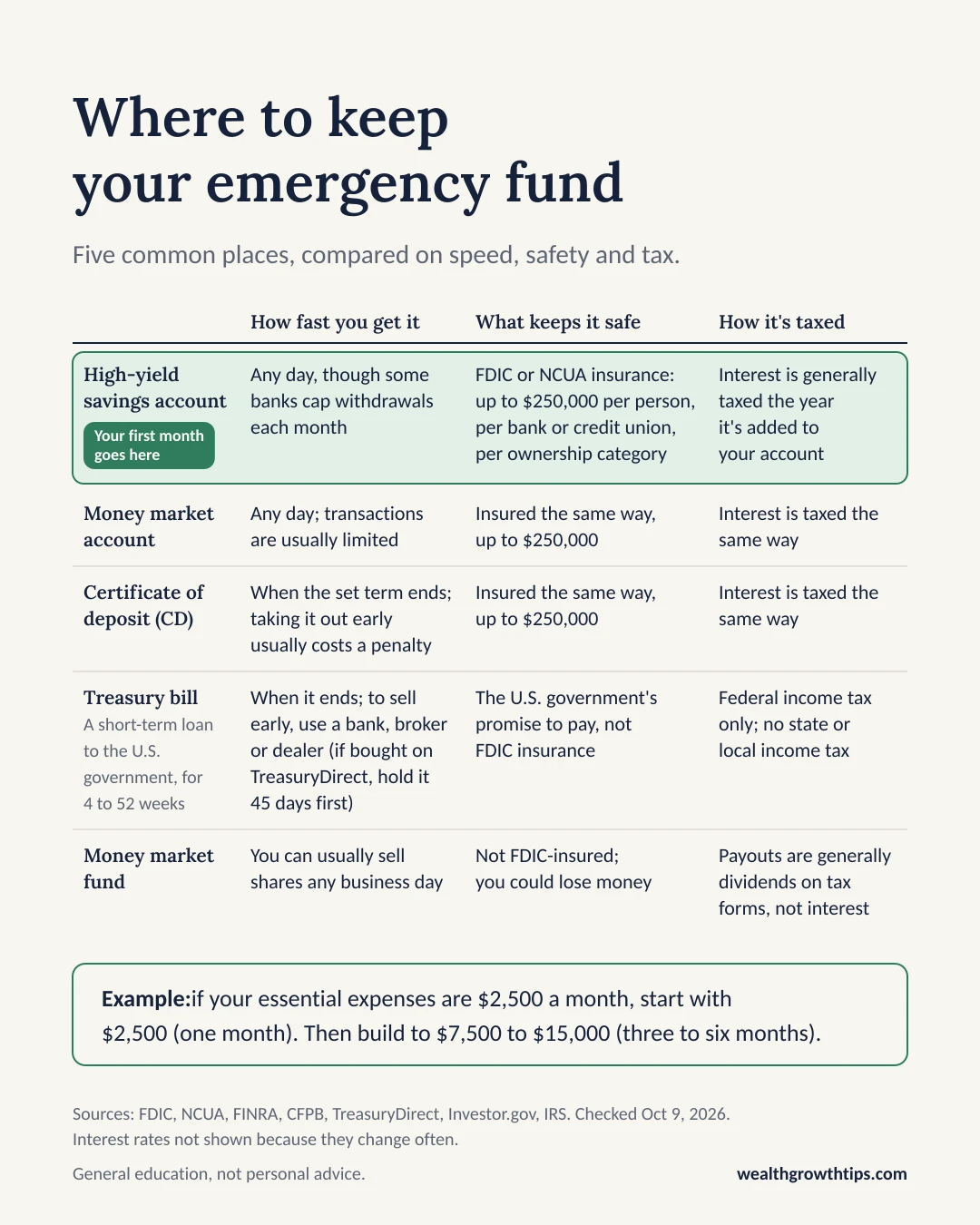
Five places, side by side
Savings is the simplest home for all of it. Money you won’t need quickly, if any, can go in a CD or Treasury bills.
- High-yield savings account. Take money out any day, though some banks cap withdrawals each month.
- Money market account. A bank or credit union account, insured like savings. It often pays more but usually limits checks, debit card use and transfers.
- Certificate of deposit (CD). Insured too, but your money stays in for a set time, like six months or a year. Taking it out early usually costs a penalty.
- Treasury bills (T-bills). Short-term loans to the U.S. government, backed by its promise to pay instead of FDIC insurance.
- Money market fund. An investment, not a bank account. Most try to keep each share at $1, and you can usually sell any business day. But it isn’t FDIC-insured, so you could lose money.
Why not just use a card or your 401(k)?
A card only works if you can pay the whole bill when it comes. If you can’t, you’ll pay interest. According to the Federal Reserve, that averages about 22% a year.
Taking money out of a traditional (pre-tax) 401(k) before age 59½ is costly too. It’s taxed as income, and most withdrawals that early also come with a 10% additional tax. And the money stops growing, as growth on top of growth shows.
Let it fill itself after payday
Set up a transfer to savings for the day after each payday. Or, if payroll allows it, split your direct deposit so part of each paycheck lands there. Raise the amount when your pay goes up. Add one-time money, like a tax refund.
After an emergency, refill the fund the same way. If part of it went on a card, pay that off first. Check your target in your annual money checkup, and any time your rent or pay changes.
What to do today
- Add up a month of essential expenses. That’s your first target.
- Pick a savings account at a different bank or credit union. Check that it’s FDIC- or NCUA-insured.
- No card debt, and nothing else at 10% or more? Set up a transfer, in any amount, for the day after your next paycheck lands. Still paying one off? Set a calendar reminder for the month you expect to finish.
More detail
What should I check before opening a CD?
Check the penalty for taking money out early, along with the rate. A no-penalty CD has none, except in the first six days. Federal rules say a CD has to block withdrawals that early or charge a penalty. When the term ends, your bank may roll the money into a new CD unless you tell it not to.
What should I know before buying Treasury bills?
TreasuryDirect, the Treasury’s own website, sells them for 4 to 52 weeks, starting at $100. You can also buy them through a bank or broker. To sell one early, you’ll need a bank, broker or dealer. If you buy on TreasuryDirect, you have to hold the bill 45 days first, so a 4- or 6-week bill there can’t be sold early.
Do I owe tax on what it earns?
Yes. Interest on savings, money market accounts and CDs is generally taxed in the year it’s added to your account. That includes what credit unions call “dividends.” T-bill interest owes federal income tax, but not state or local income tax. Money market fund payouts are generally reported as dividends, not interest.
How do I compare rates?
For savings, money market accounts and CDs, compare the yearly rate that counts growth on top of growth, which banks list as the annual percentage yield (APY). For a T-bill, compare the investment rate, not the discount rate, which makes the return look a little lower. If a rate can change, the account’s disclosure has to say so.
What if I save through an app?
Find out which bank actually holds your money. FDIC insurance doesn’t cover you if the app company itself fails.
What if an emergency hits while I’m still paying off cards?
Pause your extra payment for a month or two. Use that money for the emergency. Keep paying every minimum. Then start the extra payment again.
Can I take 401(k) money without the 10% additional tax?
Sometimes. Since 2024, a plan can offer an emergency withdrawal, which the IRS calls an emergency personal expense distribution. It doesn’t have to, so ask. You can take one per calendar year, up to $1,000. If what’s yours to keep in the plan (your vested balance) is under $2,000, the most is that amount minus $1,000. It’s taxed as income, but there’s no 10% additional tax. You can pay it back within three years. If you don’t, you can’t take another from that plan for the next three calendar years, unless what you’ve put in since adds up to at least the unpaid amount. A hardship withdrawal, if your plan offers one, is generally taxed, can still come with the 10%, and can’t be paid back.
You don’t have to understand all of this today. You just have to not quit.
The free 10-day email course walks through this and nine other things nobody in my family could tell me about money.
General education, not personal advice.
Sources (27)
- Investor.gov: World Investor Week 2026: Investor Bulletin
- Federal Reserve: G.19 Consumer Credit, release of October 7, 2026
- FDIC: Understanding Deposit Insurance
- FDIC: Banking With Third-Party Apps
- MyCreditUnion.gov (NCUA): How Your Accounts Are Federally Insured
- NCUA: Share Insurance Fund Overview
- CFPB: What is a money market account?
- CFPB: What is a certificate of deposit (CD)?
- CFPB: What is a certificate of deposit (CD) rollover or renewal?
- Investor.gov: Certificates of Deposit (CDs)
- eCFR: 12 CFR 204.2, Definitions (Regulation D)
- eCFR: 12 CFR 1030.2, Definitions (Regulation DD)
- eCFR: 12 CFR 1030.4, Account disclosures (Regulation DD)
- FINRA: Bank Products
- TreasuryDirect: Treasury Bills
- TreasuryDirect: Buying a Treasury Marketable Security
- TreasuryDirect: Selling a Treasury Marketable Security
- TreasuryDirect: Tax Forms and Tax Withholding
- TreasuryDirect: About Treasury Marketable Securities
- TreasuryDirect: Understanding Pricing and Interest Rates
- TreasuryDirect: Glossary for Treasury Marketable Securities
- Investor.gov: Money Market Funds
- IRS: Topic no. 403, Interest received
- IRS: Publication 550 (2025), Investment Income and Expenses
- IRS: Retirement topics: Exceptions to tax on early distributions
- IRS: Retirement topics: Hardship distributions
- IRS: Notice 2024-55, Emergency personal expense distributions (PDF)
Was this helpful?
That didn't go through. Please try again in a minute.
Thanks. That helps me decide what to write next.
Thanks. I read every one of these.
Ask a question
General questions only. I can't give personal advice, so please don't include account numbers or personal details.
Thanks. I read every question. If you ticked the box, it may appear on this page without your name, with my answer.
Want a private reply? Email hello@wealthgrowthtips.com.