Your first real paycheck: do these five things in this order
Why your first paycheck is smaller than you expected, and what to do with it, in order: your pay stub, your bills, your 401(k) match, your credit cards, then savings.

Your first real paycheck lands, and it’s smaller than you expected. You did the math on your salary, and the deposit came in well under it.
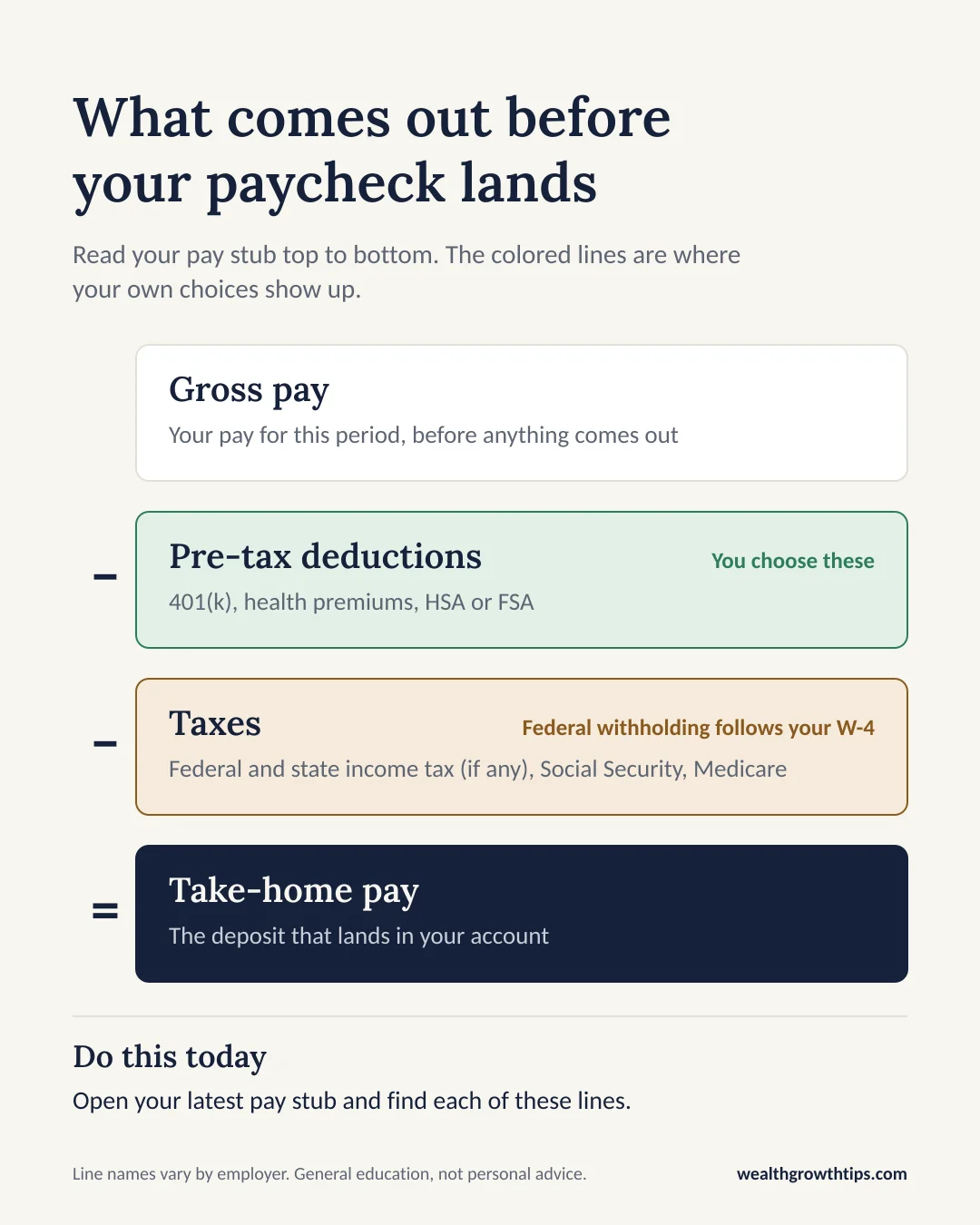
Your pay stub shows where the rest went. It starts with your pay before anything comes out, called gross pay. Some of the lines below that are choices you can still change.
Get those right in your first month, and the same paycheck does more for you. With a plan like the one in the example below, putting in 6% of your pay brings another 3% from your employer. That’s money that can start growing toward your first million.
Here are the five things to set up in your first month, in order, and the pay stub line behind each one.
First, make sure the paycheck is right
Start with the tax lines: Social Security, Medicare, federal income tax and any state income tax. Your employer generally has to take out Social Security and Medicare, so those two aren’t up to you. How much federal income tax comes out, which forms call withholding, depends on what you earn and on a tax form you give your employer, called a W-4.
If you have a second job, side income or people you support, the basic setup can take out too much or too little. A big refund at tax time usually means too much came out all year, and you couldn’t use that money until the refund came. A tax bill means too little came out. Run your numbers through the IRS Tax Withholding Estimator with your latest pay stub from each job. It can fill in a new W-4 for you.
Then look at the benefit lines: health, dental, vision, life and disability insurance, plus anything going into a health savings account (HSA) or flexible spending account (FSA). Some of these you want. Some may have been turned on by default, so check each one against what you meant to pick.
Disability insurance is easy to skip, and usually shouldn’t be. It replaces lost income if an illness or injury keeps you from working.
Then cover the basics, every minimum and your family amount
Your take-home pay, often labeled net pay, is the deposit you saw. It goes to the basics first: rent, food, utilities, getting to work, health insurance, and at least the minimum on every card and loan, paid on time.
I’ve helped support my family. If you help yours, give that help a set amount you could keep up for a year. Pay it like a bill, not out of whatever’s left at the end of the month. Sending money home without sinking your own future shows how to pick it.
Get your full 401(k) match
Your 401(k) is a retirement account through work, and what you put in shows up on your stub as a deduction. A match means your employer adds money too, based on what you put in, up to a limit.
Say your plan matches 50% of what you put in, up to 6% of your salary, and you earn $50,000 a year:
- Put in 6%, or $3,000 a year, and your employer adds $1,500.
- Put in 3%, or $1,500, and your employer adds $750. The other $750 stays with your employer.
Either way, your employer adds 50 cents for every dollar you put in, up to the limit. That’s a 50% return before any investment gains or losses. So put in at least enough to get the full match. Set it now, not later.
The match may not be yours to keep right away. Your plan’s vesting schedule says when it is. What a 401(k) match is, with real numbers shows how to read your own plan’s formula.
Next, pay off your credit cards
Card debt isn’t on your pay stub. It’s on your statement, with the card’s yearly interest rate, listed as the APR.
With every minimum paid, send every extra dollar to the card with the highest rate. When it’s paid off, move on to the next one. Do the same with any other debt at 10% or more, like a personal loan. Go by rate, highest first. You’re done when all of it is at zero. From then on, pay off the whole card balance every month.
Get your full 401(k) match while you do this. No card debt, and nothing else at 10% or more? Go straight to the emergency fund.
After that, build an emergency fund at a different bank
Once your cards are at zero, the extra money you were sending them starts your emergency fund. That’s savings for a car repair, a medical bill or a lost job.
Put it in a savings account that pays more interest, called a high-yield savings account. Open it at a different bank from your checking. The extra step gives you a moment to ask whether it’s really an emergency.
Make sure the account is federally insured. That’s FDIC insurance at a bank, or NCUA insurance at a credit union. It protects your money, up to its limits, if the bank or credit union fails.
Set up an automatic transfer for the day after payday. Aim for one month of expenses first. Then build it up to three to six months. The emergency fund timeline shows how long that takes at your pace.
After that, it’s on to debt above 6% (not your mortgage) and saving more for retirement, as what to do with extra money after paying your bills explains.
What to do today
- Run the IRS Tax Withholding Estimator with your latest pay stub from each job. If it says to, give your employer a new W-4.
- In your benefits portal, look for the words “employer match.” Set your 401(k) high enough to get all of it.
- Write down the rate on each card and on any loan at 10% or more. The highest one gets every extra dollar from now on. No card debt, and nothing else at 10% or more? Open a savings account at a different bank. Set a transfer for the day after payday.
More detail
What if my plan’s match formula is different?
Go by your plan’s own wording, not this example. Find the point where the match stops growing. Put in at least that much. The 401(k) match calculator can help you check.
Why get the match before the cards are paid off?
Because in the example plan, the match pays more. Each dollar you put in brings 50 cents from your employer. Put toward a card that charges 22% a year, the same dollar saves you about 22 cents a year. According to the Federal Reserve, 22% is about the average rate when people carry a card balance. Your own card’s rate is on your statement.
What about student loans and other debt under 10%?
Pay at least the minimum on each one, on time. Your extra money goes to the cards first, then the emergency fund. Debt above 6%, other than a mortgage, comes after that. Debt at 6% or less can stay on its minimum.
Which deductions come out before tax?
Money for a traditional (pre-tax) 401(k) generally comes out before federal income tax is figured, but Social Security and Medicare still apply to it. A Roth 401(k), if your plan offers one, comes out after tax. Health insurance, HSA and FSA money can come out before tax when your employer offers them through what the IRS calls a cafeteria plan. That’s why your stub may label them “pre-tax.”
What if I have a second job, side income or people who depend on me?
The W-4 has a step for holding more than one job at a time, a step for dependents and other credits, and a line for other income that has no tax taken out. Run the estimator again whenever your jobs or income change.
What if a deduction shows up that I don’t recognize?
Ask HR or your benefits office what it pays for and when you’re allowed to change it. Then check your next stub to make sure any change went through.
What if I can’t afford the full match yet?
Put in what you can now. Raise your rate each time your pay goes up, until you reach the full match. Each increase brings more of your employer’s money, up to the limit.
You don’t have to understand all of this today. You just have to not quit.
The free 10-day email course walks through this and nine other things nobody in my family could tell me about money.
General education, not personal advice.
Sources (16)
- IRS: Tax Withholding Estimator
- IRS: About Form W-4, Employee’s Withholding Certificate
- IRS: Form W-4 (2026), Employee’s Withholding Certificate
- IRS: Tax withholding
- IRS: Publication 505 (2026), Tax Withholding and Estimated Tax
- IRS: Understanding employment taxes
- IRS: Topic no. 424, 401(k) plans
- IRS: Publication 15-B (2026), Employer’s Tax Guide to Fringe Benefits
- IRS: Publication 969 (2025), Health Savings Accounts and Other Tax-Favored Health Plans
- IRS: Retirement topics: Vesting
- Federal Reserve: Consumer Credit (G.19), interest rates on credit card plans
- FDIC: Deposit Insurance
- MyCreditUnion.gov (NCUA): How Your Accounts Are Federally Insured
- Investor.gov: World Investor Week 2026: Investor Bulletin
- North Carolina Department of Insurance: Disability Income Insurance
- Iowa Department of Insurance and Financial Services: Emergency Savings: Your Financial Safety Net
Was this helpful?
That didn't go through. Please try again in a minute.
Thanks. That helps me decide what to write next.
Thanks. I read every one of these.
Ask a question
General questions only. I can't give personal advice, so please don't include account numbers or personal details.
Thanks. I read every question. If you ticked the box, it may appear on this page without your name, with my answer.
Want a private reply? Email hello@wealthgrowthtips.com.