Which debt to pay off first
Which debt to pay off first: the highest rate, once your minimums and full 401(k) match are covered. A worked example, plus the snowball.

It’s payday. Rent’s covered, every minimum is paid, and you’ve got $300 left over. You’re carrying balances on two credit cards, plus a personal loan. So which one gets the $300?
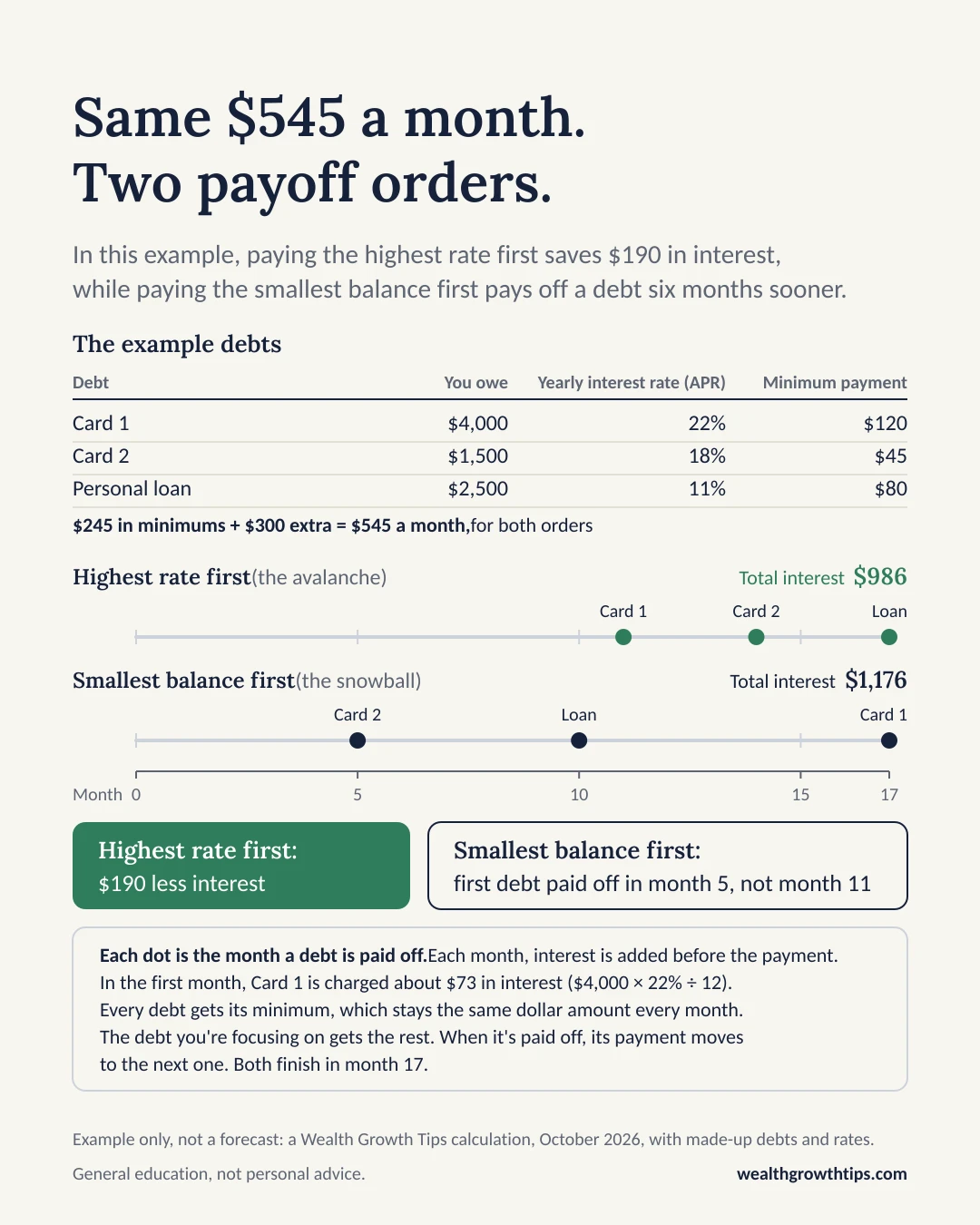
In the example below, you add $300 a month to the minimums and aim it at the highest rate. All three are paid off in 17 months, for $986 in interest. On minimums alone, they’d take 52 months and cost $3,293 in interest.
I don’t like debt. Being debt free is the best feeling. Here’s which debt to pay off first, and why.
Which debt to pay off first, in order
- Pay at least the minimum on every debt, on time. That’s the least you can pay that month without being late. Fall more than 60 days behind, and a card company can raise the rate on all your balances.
- Get your full 401(k) match. If your employer adds money when you save in your 401(k), put in at least enough to get all of it. Say they add 50 cents for every dollar you put in. Send that dollar to a 22% card instead, and it saves about 22 cents a year. The match wins. The 401(k) match guide shows how it works.
- Aim every extra dollar at the highest rate. That’s usually a card, but other debt at 10% or more counts too, like a personal loan. Everything else gets its minimum. When the top one’s paid off, add its whole payment to the next one. Your total stays the same, so the next debt goes faster.
- Keep going until your cards, and anything else at 10% or more, are at zero. From then on, pay your cards in full every month. On most cards, paying in full by the due date means no interest on purchases.
No card debt, and nothing else at 10% or more? Still get your full match. Then start your emergency fund, as what to do with extra money after paying your bills explains.
Same $545 a month: highest rate first saves $190
Why does the rate matter so much? Every $100 on a 22% card costs about $22 a year in interest. On an 11% loan, it’s about $11. And 22% isn’t unusual. In August 2026, cards that charged interest averaged about 22%, according to the Federal Reserve.
Say you owe on two cards and a personal loan:
- Card 1: $4,000 at 22%, minimum $120
- Card 2: $1,500 at 18%, minimum $45
- Personal loan: $2,500 at 11%, minimum $80
The minimums add up to $245. Add your $300, and $545 a month goes to debt, whichever order you pick. To keep the math simple, each minimum stays the same dollar amount every month. Each month’s interest is the balance times the yearly rate, divided by 12.
On Card 1, the first month’s interest is about $73. So a $120 minimum takes only about $47 off what you owe. That’s why minimums alone take so long.
Highest rate first (often called the avalanche): Card 1 is paid off in month 11, Card 2 in month 14 and the loan in month 17. Total interest: $986.
Smallest balance first (the snowball): Card 2 is paid off in month 5, the loan in month 10 and Card 1 in month 17. Total interest: $1,176.
Both finish in month 17. The snowball costs $190 more, because the 22% card waits until last. What you get for it is your first paid-off debt six months sooner. If that early win keeps you going, it can be worth the $190.
When all three hit zero, the $545 a month goes to your emergency fund next. After that, it goes to any debt above 6%, like a car loan, but not your mortgage.
Helping family doesn’t change the order
I’ve helped support my family. A card charges the same 22% whether you used it for yourself or to help someone you love. If you help your family with money, set the amount up front, like a bill. It gets paid along with rent, before any extra goes to your cards. Then your debt plan runs on money you can actually spare. Sending money home shows how to pick that amount.
Falling behind? Call your lenders first
Call the lender the day you know you’ll come up short. Tell them why you can’t pay the minimum, what you can pay and when you’ll be back on track. Ask for a lower rate. Get any deal in writing.
A nonprofit credit counselor can go over your whole budget with you. Some can set up a plan where you make one deposit a month and the counselor pays your lenders. It’s called a debt management plan. Your lenders may lower your rates or drop some fees. These plans can take 48 months or more.
Being a nonprofit doesn’t make a counselor free, or even legit, the Federal Trade Commission warns. Ask what they’ll do, what it costs and whether they’re licensed in your state. Some companies offer to settle your debts for a fee. Walk away from any that want the fee before they settle a debt. The same goes for any that promise your debt will go away, or tell you to stop paying or talking to your lenders.
What to do today
- Write down every card and loan with its balance, rate, minimum and due date.
- Sort the list by rate, highest first.
- Put every minimum on autopay.
- Check that you’re putting enough into your 401(k) to get the full match.
- Schedule a monthly extra payment to the debt at the top of your list. Pick an amount you can keep up.
More detail
Should I move my balance to a 0% card?
It can help, if you stop adding to it. Moving it is called a balance transfer. Expect a fee, even at 0%, usually a percentage of what you move or a flat amount, whichever is more. The low rate lasts a set number of months. Divide what you owe by those months to get the payment that clears it in time. When the low rate ends, the rate on whatever’s left can go up, and so can your payment. And don’t shop with that card: new purchases on it charge interest until the whole balance is paid off.
What about student loans?
Federal loans come with options most debts don’t. Some plans base your payment on your income, and for some people it’s as low as $0 a month. As of October 2026, studentaid.gov lists the Repayment Assistance Plan and Income-Based Repayment, among others. Its Repayment Calculator shows which ones you qualify for, and applying is free. A federal loan at 6% or less can stay on its minimum. Don’t trade a federal loan for a private one just to get a lower rate. You’d give up those plans and federal forgiveness, and you can’t switch back.
What if a debt goes to collections?
Don’t ignore it. Within five days of first contacting you, a collector has to send you a written notice saying who you owe and how much. It might come as a letter or an email. It’s called a validation notice. If you haven’t gotten one, ask for it. Don’t share personal or bank details until you have it, since scammers pose as collectors. If anything looks wrong, dispute the debt in writing within 30 days of getting the notice. The collector then has to stop until it sends you written proof. A federal law, the Fair Debt Collection Practices Act, sets the rules. Collectors can’t call before 8 a.m. or after 9 p.m. unless you agree. They can’t harass you or lie about what you owe. You can also tell them in writing to stop contacting you. If you’re sued, respond by the date in the court papers. And in some states, paying anything on an old debt restarts the time a collector has to sue you.
What if an emergency hits before I have an emergency fund?
Pause your extra payment for a month or two. Use that money for the emergency. Keep paying every minimum. Then start the extra payment again.
Should I use my 401(k) to pay off debt?
Usually not. Cashing out generally means income tax, plus an extra 10% tax if you’re under 59½, with some exceptions. And that money stops growing, as growth on top of growth shows.
You don’t have to understand all of this today. You just have to not quit.
The free 10-day email course walks through this and nine other things nobody in my family could tell me about money.
General education, not personal advice.
Sources (15)
- Federal Reserve: G.19 Consumer Credit, release of October 7, 2026
- CFPB: What is a credit card interest rate? What does APR mean?
- CFPB: What do I need to know if I’m thinking about consolidating my credit card debt?
- CFPB: What is a balance transfer fee? Can a balance transfer fee be charged on a zero percent interest rate offer?
- CFPB: What should I do if I can’t pay my credit card bills?
- CFPB: What information does a debt collector have to give me about a debt they’re trying to collect from me?
- CFPB: What laws limit what debt collectors can say or do?
- CFPB: Should I consolidate or refinance my student loans?
- FTC Consumer Advice: Debt Collection FAQs
- FTC Consumer Advice: How To Get Out of Debt
- Federal Student Aid: Repayment Plans
- Federal Student Aid: Income-Driven Repayment Plans
- IRS: Matching contributions help you save more for retirement
- IRS: 401(k) Resource Guide, Plan Participants, General Distribution Rules
- IRS: Topic no. 558, Additional tax on early distributions from retirement plans other than IRAs
Was this helpful?
That didn't go through. Please try again in a minute.
Thanks. That helps me decide what to write next.
Thanks. I read every one of these.
Ask a question
General questions only. I can't give personal advice, so please don't include account numbers or personal details.
Thanks. I read every question. If you ticked the box, it may appear on this page without your name, with my answer.
Want a private reply? Email hello@wealthgrowthtips.com.