Growth on top of growth, explained with the 401(k) mistake I made right out of college
How growth on top of growth works, why your first years of saving count most, and the 401(k) match mistake I made right out of undergrad.

Your paycheck comes in and most of it is already gone: rent, the car, groceries, maybe something for family. Saving for decades from now feels like it can wait until you earn more.
Here’s what starting early can do. Say you put $500 a month into low-cost index funds from age 25 to 65. If it grows 6% a year on average, which isn’t guaranteed, that’s about $1 million after those 40 years, and only $240,000 of it is money you put in.
That assumes two things: you keep investing every month, even when prices fall, and the market doesn’t stay down for a decade or two. Long slumps have happened before, so treat the million as an example, not a promise.
For how to invest it, the approach I’d point most people to is the Bogleheads three-fund portfolio: three low-cost index funds, for U.S. stocks, international stocks and U.S. bonds, held for decades. An index fund tries to match a market instead of picking a few stocks. This page covers the other half of the plan: time.
Below: the 2% mistake I made, why money grows faster the longer you leave it, two savers who show how 10 early years can almost match 30 later ones, and a slider to try your own amount.
Why my 2% mistake was bigger than it looked
Right out of undergrad, I put 2% of my pay into my 401(k), the retirement account you fill from your paycheck at work. Why 2%? It was the default, the rate you get if you never pick one. I didn’t know my employer matched up to 6% until someone at lunch asked me what my match was.
A match is money your employer adds when you put money in. The gap between my 2% and that 6% looked small on a pay stub. Growth on top of growth is why it wasn’t: a dollar you don’t collect today also loses everything it would have grown into.
So before anything else, put in at least enough to get the full match. Your plan’s formula tells you that number, and the 401(k) match guide shows how to read it.
Why money left alone grows faster every decade
Say you leave $1,000 alone and it grows 6% a year on average (an assumption, not a promise):
- After 10 years: about $1,791
- After 20 years: about $3,207
- After 30 years: about $5,743
- After 40 years: about $10,286
It roughly doubles every 12 years. That’s growth on top of growth: your money earns money, and then those earnings earn money too. So years 30 to 40 add almost as much as the first 30 years combined, because each year’s 6% is figured on a bigger amount. That’s the part nobody feels early on, and it’s why the first years of saving matter most.
Why 10 early years can almost match 30 later ones
Two people each save $200 a month, and their money grows 6% a year on average:
- Saver A starts at 22 and stops at 32, after putting in $24,000.
- Saver B starts at 32 and keeps going until 62, putting in $72,000.
At 62, Saver A has about $197,000. Saver B has about $201,000.
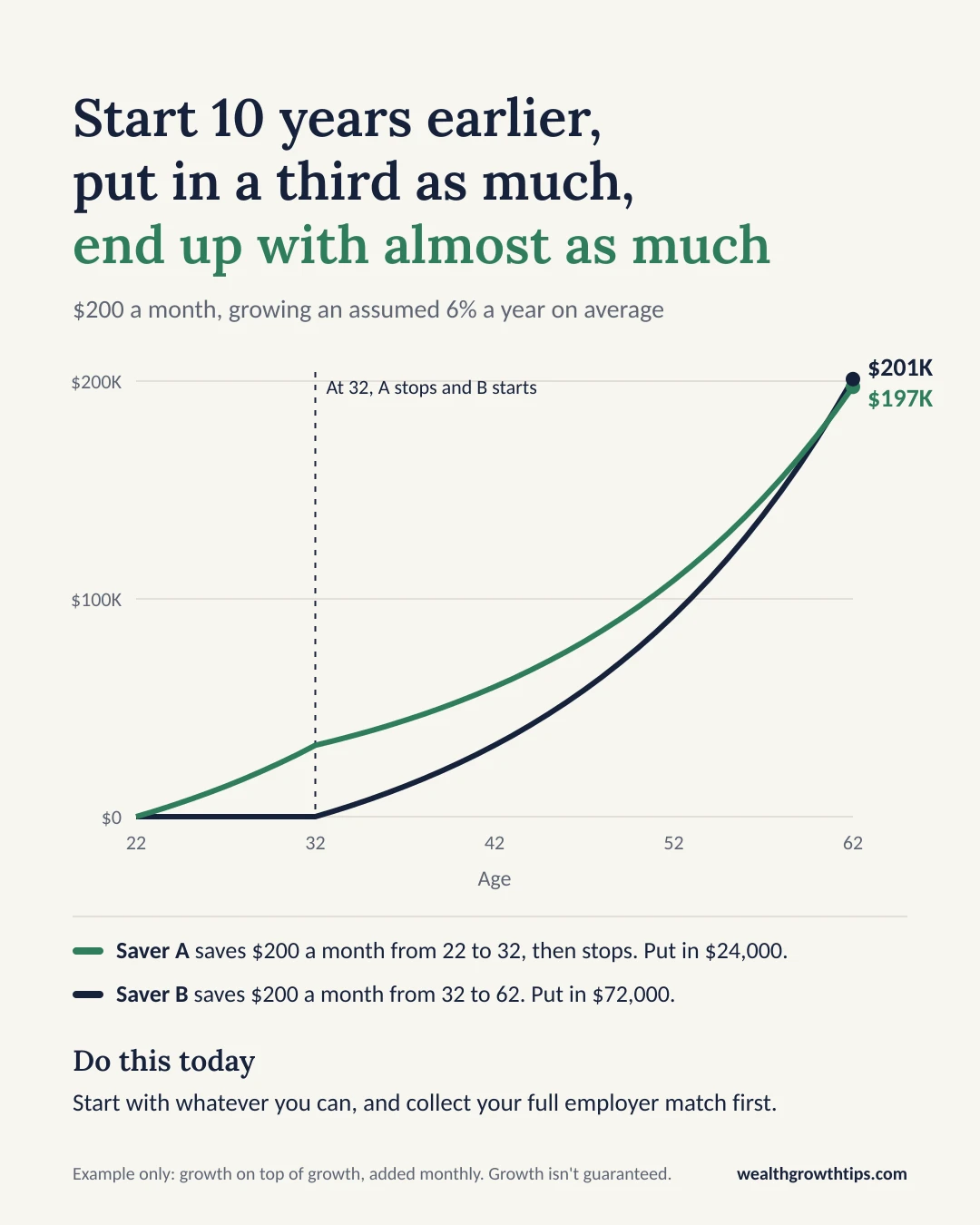
Saver A put in a third as much and ends up with almost as much, because those early dollars kept growing for 30 more years after Saver A stopped. Saver B put in three times as much and finishes only about $3,500 ahead.
Starting at 32 or later? Look at Saver B: about $201,000. Late isn’t never, and the moves are the same at any age.
What $200 a month, or the 401(k) max, could grow into
The two savers put in $200 a month. Slide that amount up to $24,500 a year, the most you can put into a 401(k) from your paycheck for 2026 (more if you’re 50 or older by the end of the year), and see what 30 years of it could grow into, starting at 22.
Try it: from $200 a month to the 401(k) max
Start at 22 and put the same amount into low-cost index funds every month for 30 years. If it grows 6% a year on average, which isn't guaranteed, here's what you'd have at 52.
At 52, after 30 years, you'd have
about $201,000
- You put in: $72,000
- Growth: about $129,000
Keep going until 65: about $485,000
Wait until 32 to start, and at 65: about $248,000
This assumes you keep investing every month, even when prices fall, and the market doesn't stay down for a decade or two. It leaves out any employer match. If you're 50 or older by the end of the year, you can put in more than the max shown. And prices tend to rise over time, so a dollar decades from now will likely buy less than a dollar today.
You can’t control growth, but you control these four things
The 6% in these examples is an assumption, not a guarantee. Prices swing, some years your money goes down instead of up, and nobody controls the average. What you do control:
- When you start. Start with whatever you can. Starting small now usually beats waiting to start big.
- How much you put in. Get the full match first. Then add 1% each time your pay goes up, so you never feel the cut.
- What you pay in fees. A fee comes out of your growth every year, so the money it takes never grows for you.
- Whether you leave it alone. Taking money out before age 59½ usually means income tax plus an extra 10% tax, and that money stops growing.
What to do today
- Log in to your benefits website and find two numbers: what you put in now, and the rate where your match stops growing.
- If the first number is lower, raise it to at least the second. The 401(k) match calculator checks your numbers.
- Put a note on your calendar for your next raise: add 1% to what you put in that week.
More detail
What does one missed year of match cost?
Say your employer matches 50% of what you put in, up to 6% of pay, and you put in 2% of a $50,000 salary. That leaves $1,000 of match uncollected for the year, and at 6% a year for 40 years, that $1,000 grows to more than $10,000. The gap repeats every year until you fix it.
Do fees make that much difference?
Yes. If fees cut your growth from 6% a year to 5%, after 30 years you’d have about a quarter less.
How can I tell how fast money doubles at other rates?
Divide 72 by the yearly growth rate. At 6%, that gives 12 years, which matches the $1,000 example above.
Will $1 million be worth as much in 40 years?
Probably not. Prices tend to rise over time, so a million dollars then would likely buy less than a million buys today. That’s one more reason to start early and raise what you save as your pay grows.
Is this what people call compound interest?
Yes. It’s the finance name for the same idea: earning money on what you put in and on what it already earned. I just call it growth on top of growth.
The free 10-day email course walks through this and nine other things nobody in my family could tell me about money.
General education, not personal advice.
Sources (14)
- Investor.gov: Investor Bulletin: Index Funds
- Investor.gov: What is Risk?
- Federal Reserve History: The Great Recession
- Federal Reserve History: Stock Market Crash of 1929
- Bogleheads wiki: Bogleheads investment philosophy
- IRS: 401(k) Resource Guide, Plan Participants, 401(k) Plan Overview
- IRS: COLA increases for dollar limitations on benefits and contributions
- IRS: Retirement topics - Catch-up contributions
- U.S. Department of Labor: A Look at 401(k) Plan Fees (PDF)
- IRS: Topic no. 558, Additional tax on early distributions from retirement plans other than IRAs
- IRS: Retirement topics - Exceptions to tax on early distributions
- Investor.gov: What is compound interest?
- Investor.gov: Compound Interest
- Federal Reserve: Why does the Federal Reserve aim for inflation of 2 percent over the longer run?
Was this helpful?
That didn't go through. Please try again in a minute.
Thanks. That helps me decide what to write next.
Thanks. I read every one of these.
Ask a question
General questions only. I can't give personal advice, so please don't include account numbers or personal details.
Thanks. I read every question. If you ticked the box, it may appear on this page without your name, with my answer.
Want a private reply? Email hello@wealthgrowthtips.com.